Before you buy a tiny home for this winter, read the heat section
We read 137 active listings. 68 name a mini-split. The ones worth a call also say where the water is, and what heats the house when the power goes out.

Published under the Nomad Adjacent masthead. This guide was produced with AI assistance and is bylined to the company rather than an individual writer — we don’t attach invented author names to it. Read our editorial standards, or email us to request a correction.
It's the last week of October. If the tiny home you're buying is where you plan to sleep in January, read the heat paragraph before you fall for the loft. The loft will still be there in five minutes.
We read the 137 listings that are active on Nomad Adjacent this week. A mini-split, heat pump, or ductless unit is named on 68 of them. That line is now standard. It tells you a heating and cooling box exists. It leaves out the size, what runs when the electricity dies, and where the water sits once the temperature is well below freezing. This is a reading of those listings. We didn't crawl under the trailers.
A listing you can make a winter decision from answers three things. What heats the house, and what heats it when that quits. Where the fresh water is. Whether the belly of the trailer is closed. Plenty of listings have the first half of the first answer. The useful ones keep going.
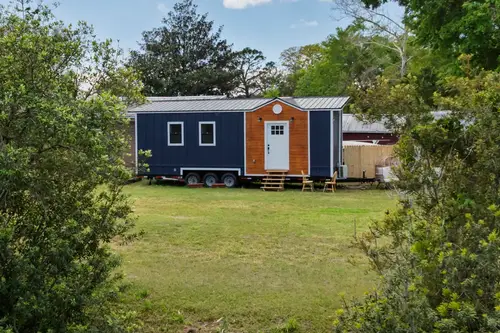
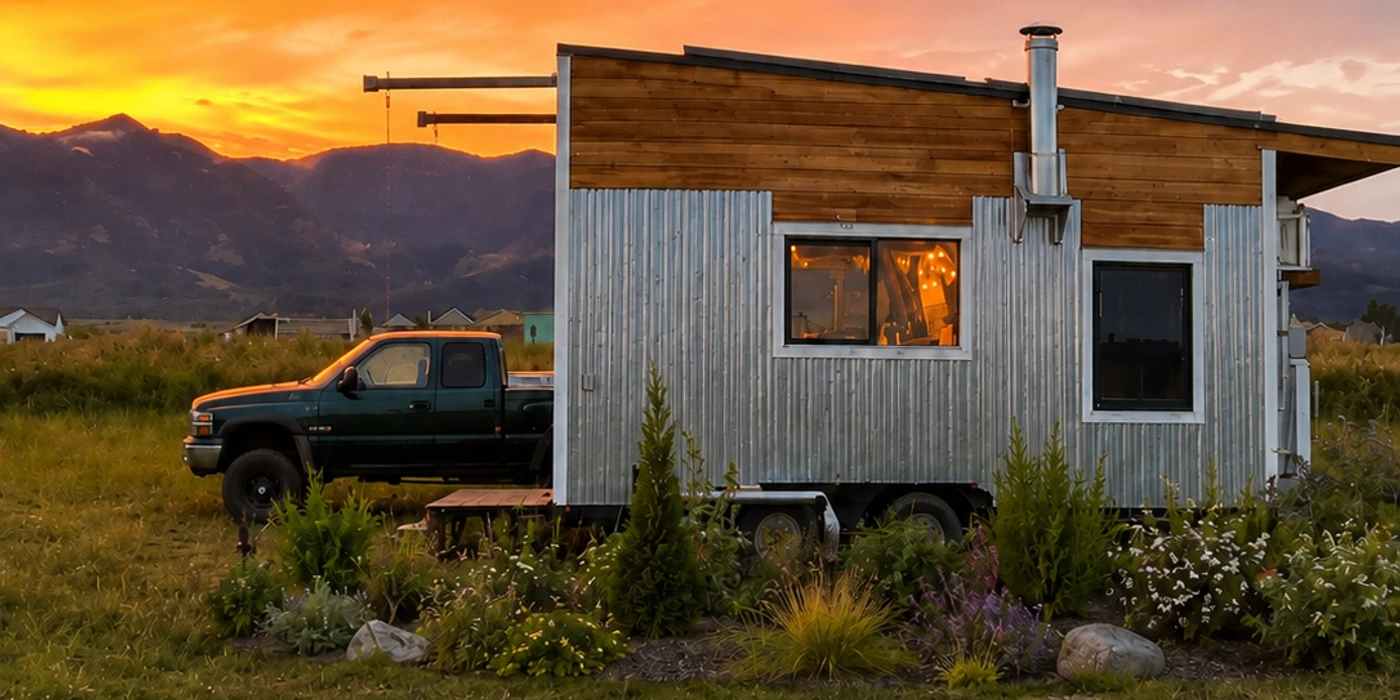
The house in the photo above is listed at $37,500 in Star Valley Ranch, Wyoming. It's a 2022 tiny home on wheels, 170 square feet. The listing names a Pioneer 9,000 BTU mini-split and a Dwarf 5kW mini wood stove. You can see the flue. It lists spray foam and fiberglass, and it gives thicknesses: 8 inches in the floor and ceiling, 4 inches in the walls. It names a 100-gallon fresh tank and two grey tanks. It never says whether that fresh tank sits inside the heated shell. Good listing. One hole. That hole is the question.
What one line about heat leaves out
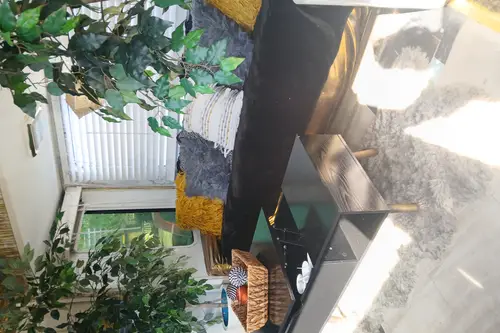
This 2020 Tumbleweed, a 30-foot Elm listed at $100,000 in Jackson, Wyoming, says it was "tried and tested through 4 winters in Jackson Hole." The heat equipment in the writeup is an AC/heat mini-split. The photo here is that unit, high on the kitchen wall. Other photos on the listing show the house on piers, underside open. There's no skirt in the writeup, no stove, no line about where the tanks are. Four winters in that town is a serious sentence, and it's doing almost all of the work. If you call, those winters are the reason to ask what they did on the coldest nights.

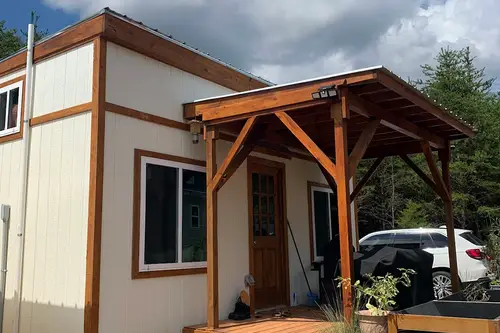
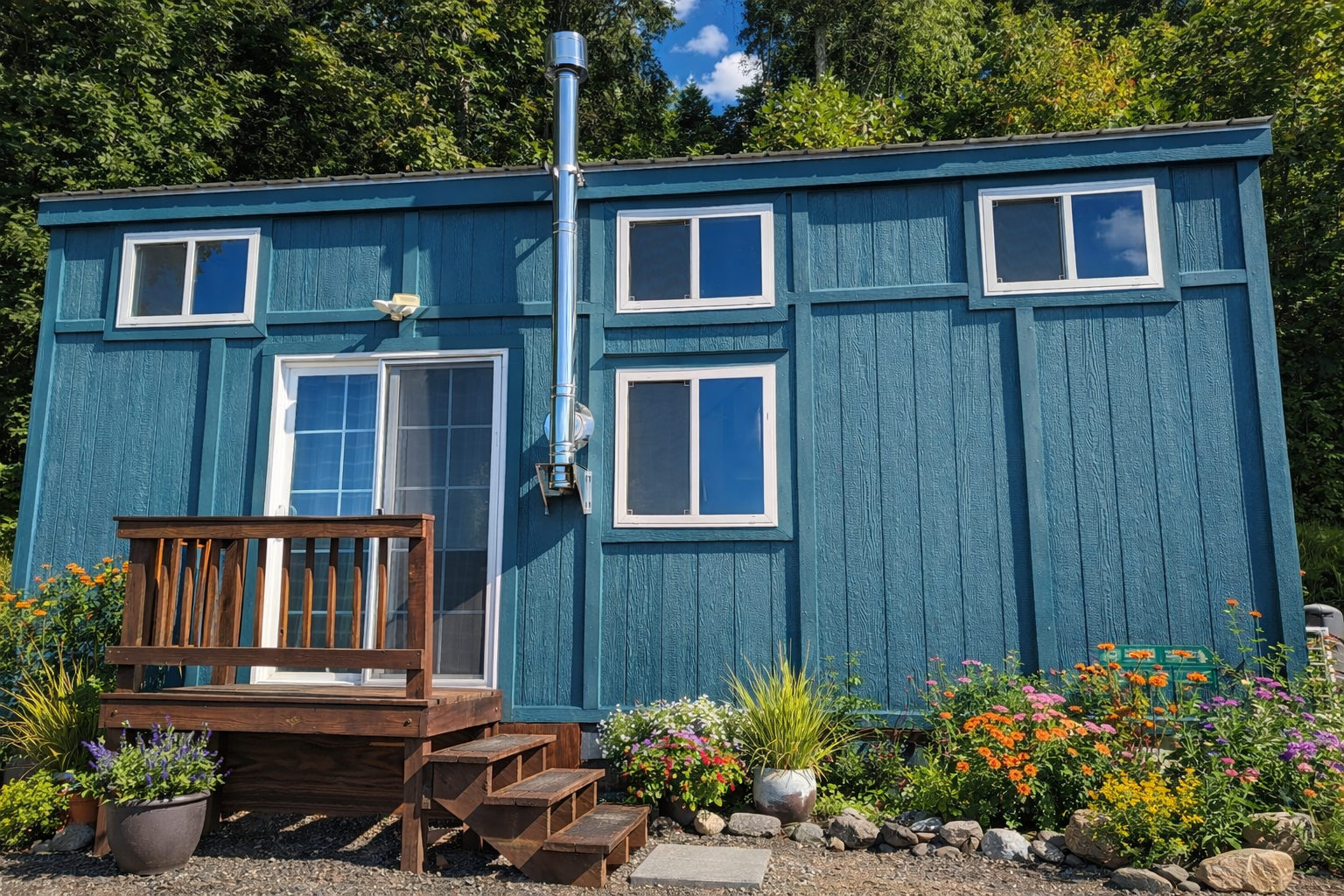
The blue house listed at $66,000 in Floyd, Virginia, writes the second source down. A mini-split for heating and cooling. A Dwarf wood stove "for backup heat." The water system is insulated, with heat tape. The listing title says the home is in a community. The stovepipe is the backup you can see from the yard. A mini-split needs household current. A wood stove needs wood, and a flue that drafts. Both belong in the ad. Here, they do.
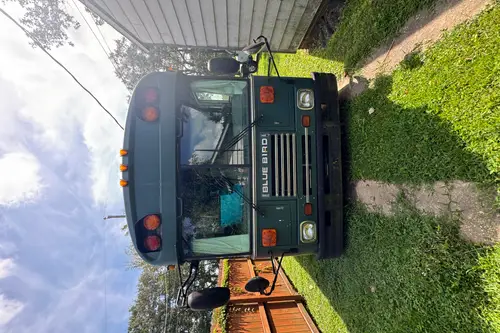
A 2022 cargo-trailer conversion listed at $65,000 in Colorado Springs is the same idea in a different shell. The listing says they've lived in it through single-digit lows and more than a foot of snow. The equipment is a 9k BTU mini-split and a 12-volt diesel heater. The 100-gallon fresh tank is inside. The 40-gallon grey tank is in an insulated box. The outside of the box is 20 feet by 8 feet. A diesel heater burns fuel and draws a little 12-volt power for the fan. It is only a backup if the exhaust is actually vented to the outside. The listing names the heater. Ask to see the vent.
Where the water sits
A cold bedroom is an uncomfortable week. A frozen tank can mean opening up the floor. Read the plumbing the way you read the price.
A 2023 tiny home on wheels listed at $82,500 in Lancaster, Pennsylvania, says all the water tanks are inside the building envelope "to combat freezing concerns during winter." It also names a mini-split with a heat pump, heated floors, a propane generator for auxiliary charging, and a propane fireplace it calls a Dickenson Marine. The shell is spray foam in the 2x4 walls and the 2x8 rafters, plus another half-inch of insulation outside. That's a full answer. You still confirm it in person. You at least know what you're looking at.
The seller of this 2022 house, listed at $70,000 in Canton, Ohio, already wrote the paragraph most people leave out. They lived in it through two Ohio winters, which they describe as climate zone 5a. Then, in their words: "Unless you skirt the bottom space, I would personally advise against full-time living in a cold environment." Short winter stays, they say, are comfortable. Consistent use of the shower and the stove top, in a well-sealed space, built up moisture, and condensation showed up in the cooler corners. The heat they name is specific: a Dickinson propane yacht heater, a 1,000-watt toe-kick heater under the sink, R-13 in the walls, R-18 in the roof. The photo shows the chassis open. The paragraph and the photo agree.

A renovated 30-foot Airstream listed at $82,000 in Honeoye Falls, New York, has a new 45-gallon fresh tank inside, and the listing says it's inside so the trailer can be used four seasons. Heat is a mini-split. The same ad says to run that mini-split selectively if you want the solar and batteries to cover daily use without shore power. The heat and the power budget are one conversation. They treated it that way.
The skirt in the photo
Same seller, two park models in Nathrop, Colorado, both written around snow. Tighter trusses for snow load. A 40,000 BTU propane furnace. The lofted one is listed at $83,300, plus delivery and tax, and the ad describes it as 399 square feet plus a 180-square-foot loft. The no-loft model is listed at $76,200, plus delivery and tax. Both ads then say insulated skirting, the steps, and the hookup are not in the price. The photo on the lofted listing shows a skirted house, with steps and a porch. Ask which of those comes with the unit you're actually buying. If that house spends this winter in Nathrop, the skirt is part of the purchase.

The other version of that sentence is on a tiny home listed at $75,000 in Bennington, Vermont. The seller says it has been used in a northern climate. The list names removable insulated wood skirting, an insulated water hose, heat tape, a heated greywater hose, a heat-recovery ventilator, and a 12,000 BTU mini-split they describe as rated for negative temperatures. "Winter-ready" is in the ad too. The list is the part you can check. Ask for the mini-split's model number and match it to that cold-weather claim when you're standing in front of it.
Optional means it is not on the trailer
Three listings from the same seller in Cañon City, Colorado, are builder specs. The year on them is 2026, and the buyer picks colors and finishes. Read "comes with" and "optional" as the order sheet. A finished house in the photos may be the display. Confirm the heat list belongs to the unit you're buying.
The 24-foot off-grid bunkhouse, listed at $62,875, includes a mini-split and a wood-burning stove. Propane heat is an add-on at $975. The 22-foot bunkhouse, listed at $57,500, puts a Cub wood stove, a propane heater, and a mini-split under "comes with." The 24-foot single-story model, listed at $47,785, includes a mini-split and a propane heater "for additional warmth in cold winter weather." Three ads, three different heat answers. If you want the $62,875 house and you also want the propane heater, the listing says that heater is extra. Get it on the order. A photo of a finished model is not your build sheet.
A Lux tiny home listed at $129,000 in Orchards, Washington, titled as a 2024, draws the same line. Closed-cell spray foam is listed at R-24. The included heat is a DELA mini-split. The wood-burning stove is under optional upgrades, next to solar and a deck. A stove you might add later is not heat in the house you're buying this month.
Ask this before you send a deposit
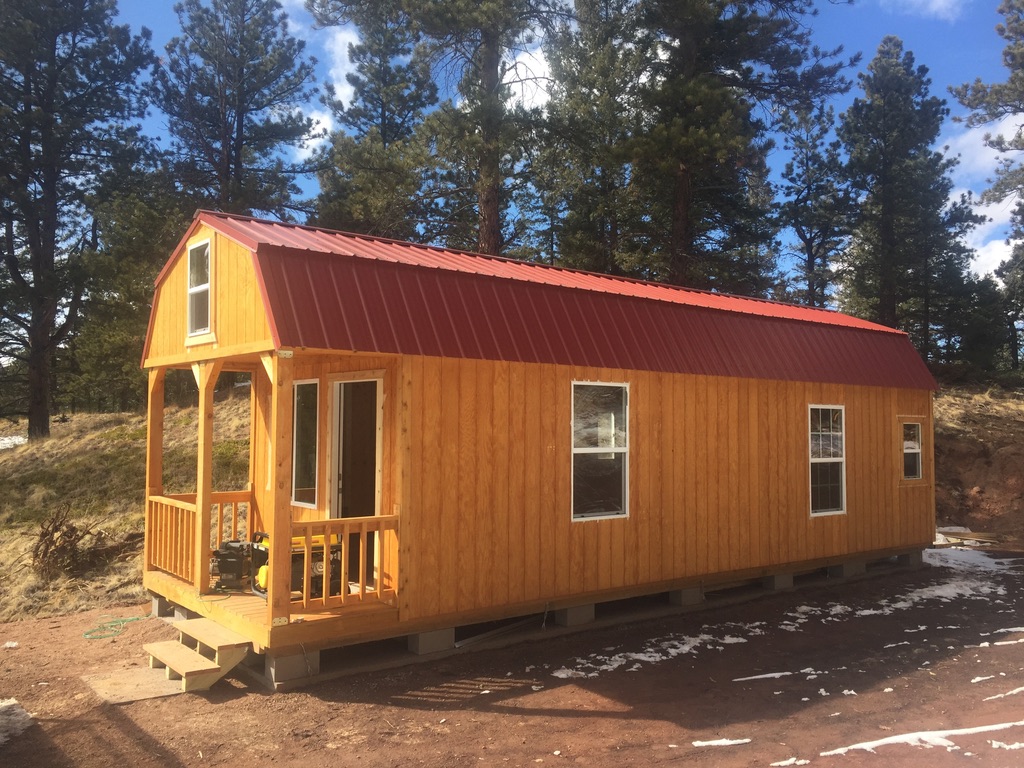
When the ad names the hardware, you can look it up before the phone call. This cabin in Woodland Park, Colorado, listed at $125,000, was finished on site in 2018. The listing says it has never been moved. "Four-season comfort," in their words, is Warmboard radiant floor heat, a Taco mixing system, Rinnai forced-air propane heat, and a Rinnai on-demand water heater. The photo shows it up on blocks, with snow on the ground. That equipment list answers the photo. "Heated" would have told you nothing.
Write the size down so you have something to compare. The Star Valley mini-split is 9,000 BTU. The Colorado Springs ad writes theirs as 9k. A tiny home listed at $95,000 in Pipersville, Pennsylvania, calls its mini-split 18,000 BTU and "larger than normal for such a small space." The feature list names a Fujitsu, so treat that as the same unit unless the seller says there are two. That house also has heated floors. The Nathrop furnace is 40,000 BTU, in a much bigger park model. Put the backup next to the number. The Wyoming unit is 9,000 BTU beside a wood stove. The Pennsylvania listing leads with 18,000 BTU. A missing number still tells you nothing.
Send this list before you talk price. Paste it in the message.
- What heats the house? Brand and BTU, not "heated."
- What heats it when the power is out? If the only answer is the mini-split, ask what the battery bank will actually run, and for how long. "The solar handles it" needs a load attached to the sentence.
- Where is the fresh water tank? Is the grey plumbing inside the heated shell, or under the trailer with heat tape?
- Is skirting included, is it insulated, and does the skirt in the photos come with the sale?
- Has anyone slept in it below freezing, for more than a weekend? What did the windows do? The Canton seller's condensation note is the failure a single cold Saturday won't show you.
- If the ad says optional, custom, or "customer chooses," ask for the build sheet for the unit you are buying. Not the sheet for the one in the photo.
Prices and wording here are what those listings said on October 26, 2026. They change. Open the listing before you repeat a number. If you ask these questions and the seller is annoyed that you asked, you learned something the photos were never going to tell you.
Off-grid gear deserves the same reading. Panels in a photo and panels on a roof are not the same claim. We went through that separately. The homes themselves are in search.