Off-Grid Tiny Homes for Sale: How to Read the Listing
We read all 35 listings on our site that mention off-grid or solar. About 15 describe panels and batteries already installed. How to tell them apart.

Published under the Nomad Adjacent masthead. This guide was produced with AI assistance and is bylined to the company rather than an individual writer — we don’t attach invented author names to it. Read our editorial standards, or email us to request a correction.
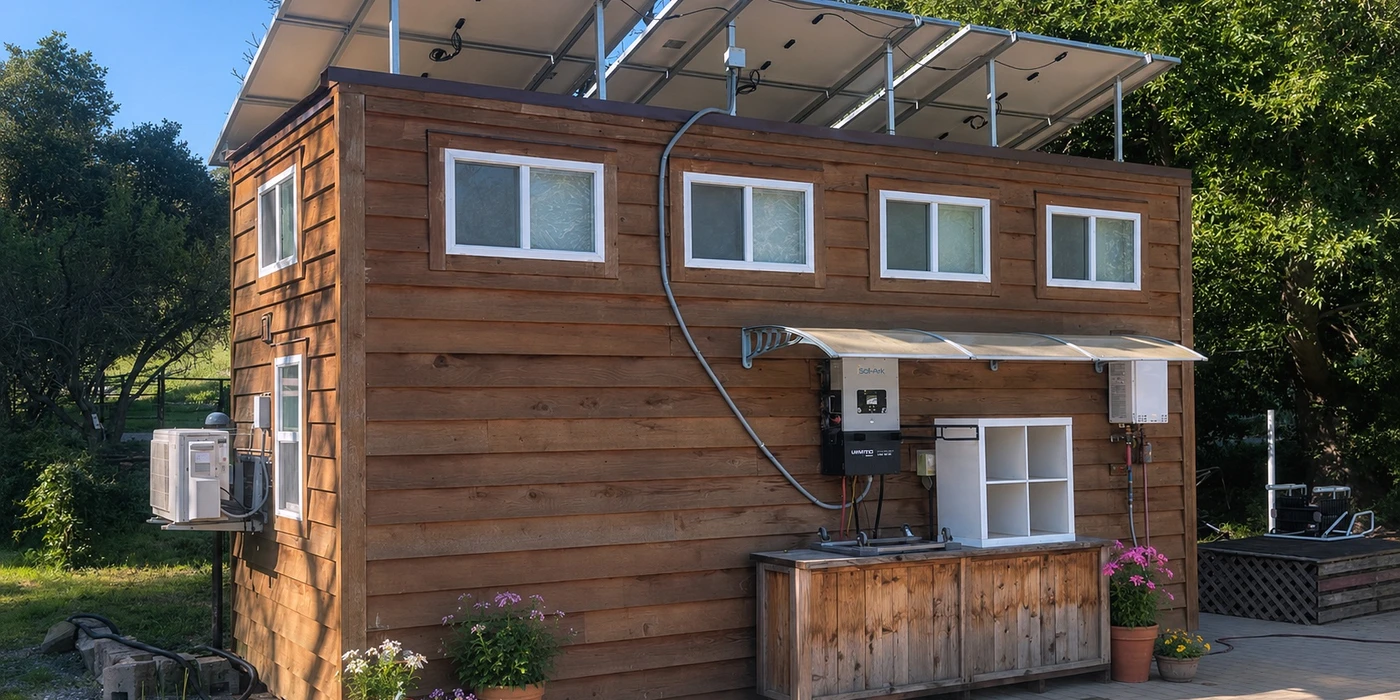
As of September 27, 2026, there are 142 homes for sale on Nomad Adjacent, and 35 of them mention "off-grid" or "solar" somewhere in the description. We went through all 35, line by line, because the phrase means a lot of different things depending on who typed it. A fully off-grid tiny home makes its own power (usually solar panels, a battery bank and an inverter), carries its own water, and handles waste without a sewer line.
By our count, only about 15 of those 35 describe solar panels and batteries as already installed. The rest say the home is "off-grid capable" or "solar-ready," list solar as an upgrade, or have panels with no usable batteries. A couple of sellers say plainly that their home isn't set up for off-grid living at all, which we appreciate.
None of that makes the other 20 bad homes. It does mean the word "off-grid" in a listing tells you almost nothing until you read the equipment list. Below, we use real listings on our site to show how to read one, and cover what changed in 2026 for anyone planning to add solar themselves.
The four things sellers mean by "off-grid"
1. It's installed
Most buyers picture this one: panels on the roof or on a ground rack, a battery bank, an inverter, water tanks, and some kind of toilet that doesn't need a sewer line. The good listings spell it out.
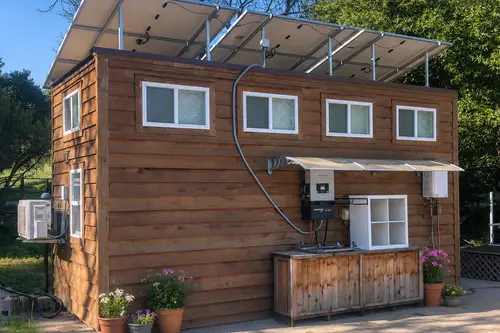
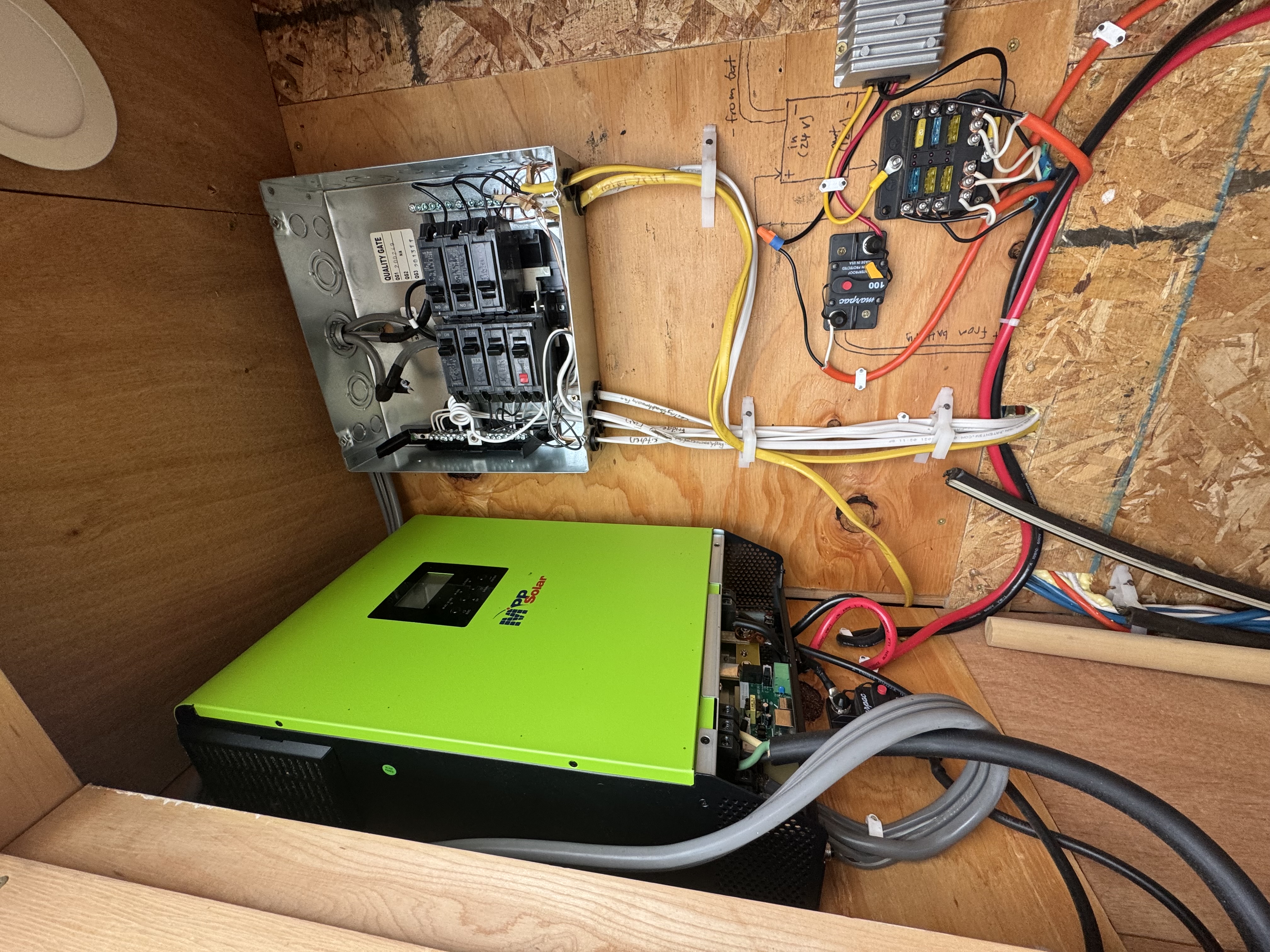
A 2022 tiny home in Star Valley Ranch, Wyoming ($45,000) lists eight 280 amp-hour lithium iron phosphate cells, six 400-watt panels, a 2,400-watt hybrid inverter, 100 gallons of fresh water, two grey tanks, a Laveo dry flush toilet, a mini-split, and a small wood stove. The listing even includes a photo of the inverter wall, which few listings do.
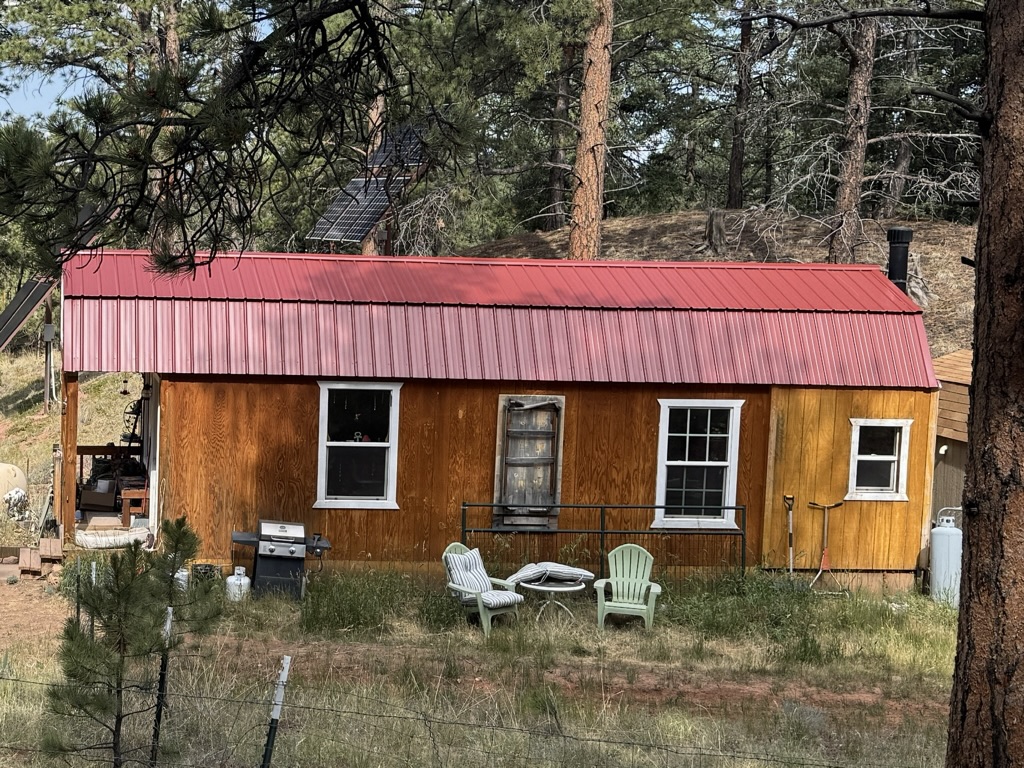
A cabin in Woodland Park, Colorado goes further, with ten panels on two adjustable steel arrays, a Magnum inverter, two SimpliPhi lithium batteries, a 550-gallon cistern, and a Winco generator that starts itself when the batteries hit a set low point. The seller prices the cabin at $125,000 and offers the whole solar, water and septic setup separately for $25,000, which gives you a rough idea of what one seller thinks a complete system is worth. For scale, the median asking price of all 142 homes on the site is $70,000. The listing is also clear that the buyer is responsible for moving the cabin and setting it up on the new site.
2. Panels, but no batteries
It's easy to miss this one. A steel-framed tiny home in Linn Creek, Missouri ($84,500) has 3,200 watts of Canadian Solar panels and a 6,000-watt Humless hybrid inverter, and the listing says it's ready for a compatible 48-volt battery system, with the battery not included. Until you add a battery, the solar can't carry anything after dark.
A $20,000 skoolie in Cantonment, Florida has the same gap for a different reason. The seller lists 1,160 watts of solar and a Victron setup, then says the batteries are not in usable condition and will need replacing. Good on the seller for saying so, but budget for new batteries.
3. "Off-grid capable" and "solar-ready"
After installed systems, this is the most common version, and it's the vaguest. A 2023 tiny home in Fredericksburg, Texas ($29,000) describes itself as off-grid capable "when connected to an appropriate solar setup" and calls the design solar-ready. A 2021 Escape in Nederland, Colorado ($67,000) says solar isn't installed but the electrical setup could potentially be adapted.
Both sellers are straightforward about it, and either could be a good home. Just keep in mind that "capable" means later. As listed, you'd be buying a house that runs on shore power, and the off-grid part is a project you'll pay for.
4. It's on the build sheet as an upgrade
One seller in Cañon City, Colorado who builds to order has several new homes listed with us. One lists "full time solar off grid" under upgrades available, and another at $82,000 says a solar off-grid package is available, with the price shown as "$$$." New builds are often listed that way. Just assume the price you see doesn't include it.
At the other end, a $140,000 Japandi-style tiny home in Santa Fe says it was "designed for connection to an established site rather than off-grid living." It has no onboard water tanks and no solar, and we wish more listings were that clear about what a home isn't.
What changed in 2026 if you plan to add solar yourself
Until the end of last year, if you bought a solar-ready home, lived in it, and added panels and batteries yourself, you may have been able to claim the federal Residential Clean Energy Credit, which was 30% of the cost. The 2025 tax law commonly known as the One Big Beautiful Bill (Public Law 119-21, July 4, 2025) ended it, and the IRS now says the credit "is not available for any property placed in service after December 31, 2025." The IRS goes by the date the installation is finished, not the date you paid, so a system paid for in 2025 but finished in 2026 doesn't qualify either.
What that means for a buyer this year:
- If you add solar and batteries to a "capable" home in 2026, there's no federal residential tax credit to offset it.
- A home that already has a system comes with equipment you'd otherwise buy without that help, so it's reasonable for sellers to price it in, and you should ask how old it is.
- If a listing or a builder's brochure still says the solar "qualifies for the 30% tax credit," it's out of date for the residential credit on anything installed now.
This isn't tax advice. If you're counting on a credit of any kind, including state or utility programs, ask a tax preparer.
How to read the numbers in a listing
Off-grid listings throw a lot of numbers at you, and three of them matter most.
Watts on the roof
Panel wattage tells you how fast the system can charge in full sun. It doesn't tell you how much power you get in a day, and it definitely doesn't tell you what you get in December.
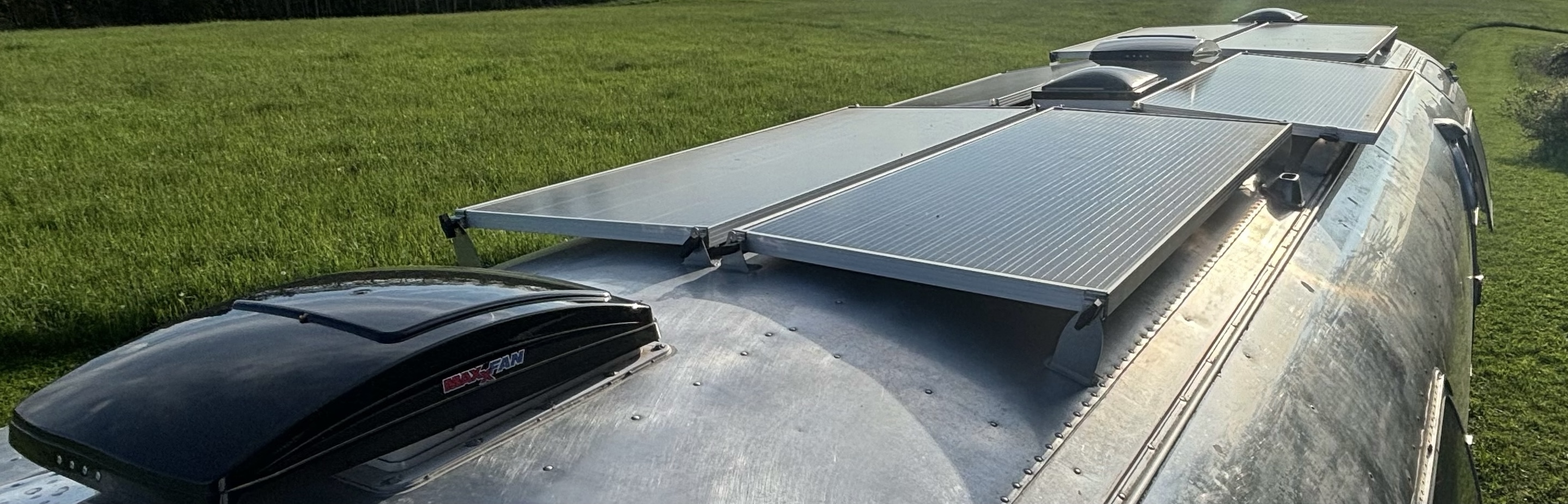
PVWatts, a free calculator from the Energy Department's national lab in Colorado, will estimate it for any address. We ran it for panels laid almost flat, the way they usually sit on a tiny home roof. In Cheyenne, each kilowatt of panels makes about 72 kWh in December and about 166 kWh in June. In Seattle it's about 27 in December and 134 in June, roughly a fifth of the summer output.
Use the Cheyenne numbers as a rough stand-in for the Wyoming home above (Star Valley is on the other side of the state, so run PVWatts for the actual site). Its 2,400 watts of panels, if they're mounted nearly flat, would average something like 5.5 kWh a day in December and around 13 in June. Those are modeled numbers. Snow on the panels, shade and dirty glass all come off the top.
Tilt helps a lot in winter. PVWatts puts a Denver array tilted at 60 degrees at about 126 kWh per kilowatt in December, which is more than that same array makes in June. Adjustable racks, like the two steel arrays on the Woodland Park cabin, are worth having for that reason. So is the spot you park on. The container home in Castro Valley says it needs "good southern exposure on a flat surface," and where the panels will face on your land matters as much as how many there are.
Battery size, in kilowatt-hours
The battery bank is what keeps the lights on through cloudy stretches. Sellers list batteries all kinds of ways, so do the math yourself: volts times amp-hours equals watt-hours. Divide by 1,000 for kWh.
The Wyoming home's eight 3.2-volt, 280 amp-hour cells work out to about 7.2 kWh. The Airstream in New York lists six 100 amp-hour Battle Born batteries. Battle Born's BB10012 is a 12-volt, 100 amp-hour battery, so if that's the model, you're looking at about 7.2 kWh there too.
For scale, the average U.S. home used 865 kWh a month in 2024, according to the EIA, or about 28 kWh a day. Nobody lives in a tiny house the way they live in a full-size house, and propane or wood for cooking and heat takes a big load off the batteries. But if you're planning to run a mini-split all winter on a 7 kWh bank, do that math before you buy.
What kind of battery, and how old
Battery type matters more than size, because lithium iron phosphate (LiFePO4) and lead-acid batteries age differently.
A 2022 Pacific Northwest National Laboratory report for the Department of Energy, written about grid-scale storage, put lead-acid life at 3 to 4 years at one deep cycle a day. The same report lists lithium iron phosphate at around 4,800 to 6,000 cycles depending on how deep you drain it, and cites lithium warranty terms of 10 to 15 years. Trojan, a lead-acid battery maker, recommends using only 20 to 50% of rated capacity for the best life, so a lead-acid bank has less usable energy than the label suggests.
Cold is the other issue. Battle Born's data sheet says its standard batteries won't take a charge below about 25°F unless you buy the heated version, and Trojan says to keep its batteries above 60% charge below 32°F. If the batteries live in an unheated box outside, ask about this.
The Castro Valley listing gives you just enough to know what to ask. It has a 48-volt system with eight 6-volt batteries in an outdoor box, and the seller says they're four years old with an estimated 10-year lifespan. The listing doesn't say what type they are. We'd ask that first, because lead-acid and lithium batteries age very differently.
Water and toilets are where off-grid gets legal
Power is mostly a money question. Water and waste are where the county gets involved, and a lot of buyers skip this part.
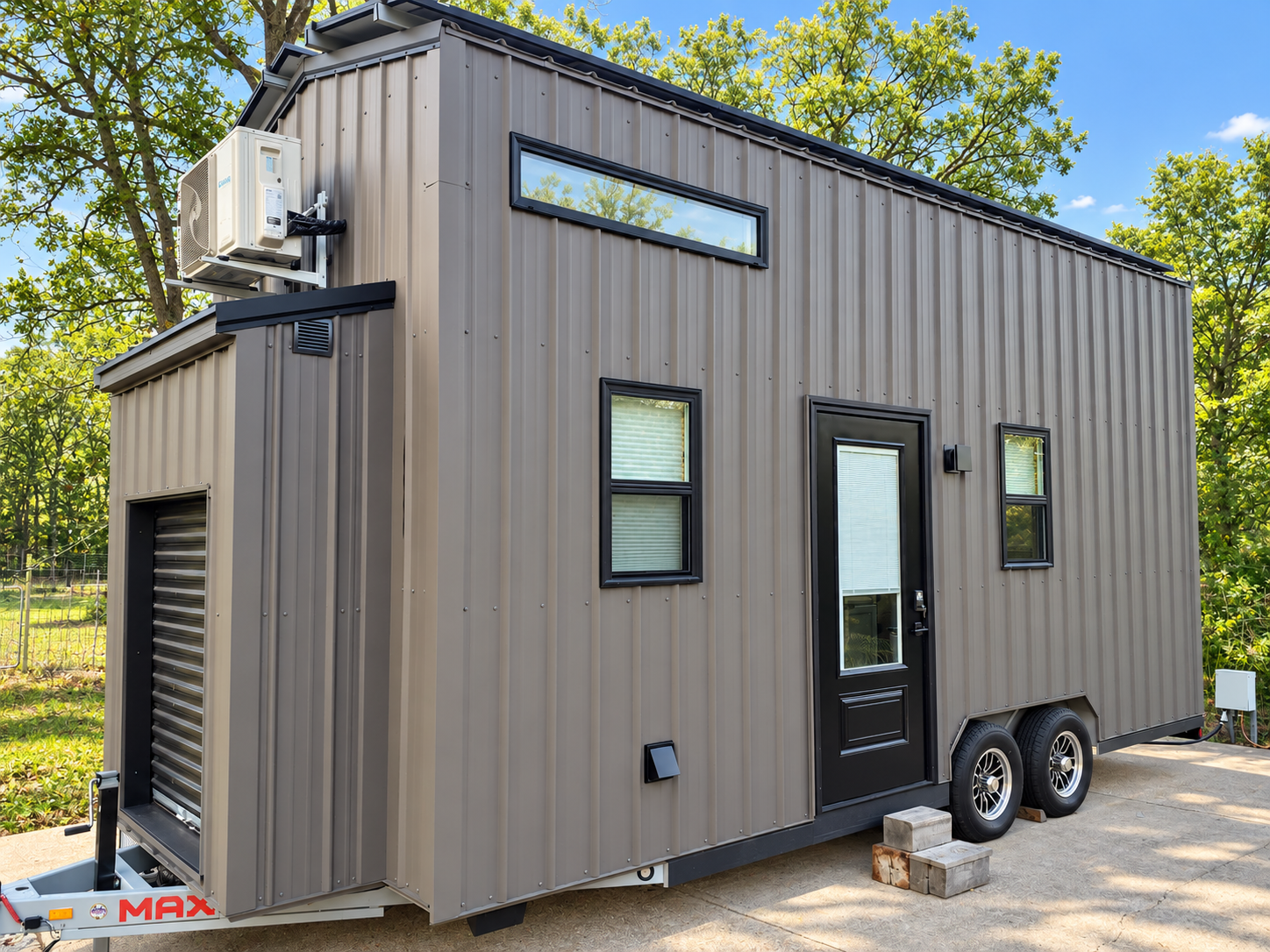
Plenty of these homes come with composting, incinerating or dry flush toilets. Those are usually the right call for a home that moves. But in several states, a waterless toilet doesn't get you out of dealing with the rest of your wastewater.
- Colorado's Regulation 43 lets the local board of health permit composting and incinerating toilets, but says using one "will not reduce the required size" of the septic system, except in limited cases where the local health agency allows a smaller soil treatment area for a building with no flush toilet. Composting toilets have to meet the NSF/ANSI 41 standard.
- Washington says a greywater irrigation system isn't a substitute for an approved septic system or sewer, and it specifically includes buildings with waterless toilets.
- Oregon allows compost toilets approved by the state Building Codes Division, and under its split-waste rule, sink, shower and laundry water goes to a septic system (which can be smaller in some cases) or a sewer.
- In Texas, the state's approval sheet for at least one composting toilet notes that "an approved on-site sewage facility will be required for disposal of all other wastewater."
Some states are looser on greywater. Texas doesn't require state authorization for residential greywater used under its rules for things like gardening and landscaping, and Arizona covers residential greywater under 400 gallons a day with a general permit, as long as you follow its conditions (no spraying, no surface watering of food plants other than trees and shrubs whose edible part doesn't touch the water, and so on). Local rules can still be stricter, so call the county.
Rainwater has its own rules. In Colorado you can collect rain from your roof without a permit, but only in up to two barrels holding 110 gallons combined, for outdoor use on the same property, per the Colorado Division of Water Resources. So if a home comes with a big tank, like the 550-gallon cistern on the Woodland Park cabin, ask how it gets filled where you plan to put it. The listing doesn't say, and the answer depends on your land and your state.
Heat: count the backups
The better off-grid listings almost always have more than one way to stay warm. The Wyoming home has a mini-split plus a small wood stove, with propane for hot water and cooking. A 22-foot bunkhouse from Cañon City at $57,500 lists a Cub wood stove, a propane heater and a mini-split. You want more than one, because a mini-split is great until the batteries run low during a cloudy week in January.
If there's a wood stove, check two things. New wood heaters sold in the U.S. have to meet EPA emission limits, and the EPA keeps a database of certified models. And call your insurance company before you buy, not after. Progressive notes that some insurers want a wood stove professionally installed and inspected, while others only want a photo. Anything burning propane or wood also calls for working carbon monoxide alarms. The International Residential Code requires them in new homes with a fuel-fired appliance, and they're cheap either way.
What to ask before you make an offer
We'd send any seller of an off-grid home these questions:
- What's the total battery capacity in kWh, what type are the batteries, and when were they installed?
- How many watts of panels, how are they mounted, and can they be tilted?
- What's the inverter, and does it have a generator input?
- How did the system do last December? Did you run a generator, and how often?
- Where do the batteries and water tanks live, and are they protected from freezing?
- What kind of toilet, and where does the grey water go right now?
- What are all the heat sources, and which ones work with no electricity?
- Is the solar equipment included in the price, or sold separately?
Every listing on the site has a Contact Seller button, so you can send these straight to whoever posted the listing. A seller who has lived with the system should be able to answer all of them.
Where to start looking
You can browse every tiny home for sale on the site, or start with Colorado, which has more listings mentioning off-grid or solar than any other state on the site as of this writing. If you'd rather have a system designed for your land from scratch, the builder directory is the place to start, and if you're still figuring out where you can legally put a home at all, look at the tiny house communities first.
Whatever you look at, read past the word "off-grid" to the equipment list. If the list isn't there, ask for it.
Sources
- Nomad Adjacent active listings, reviewed September 27, 2026. Equipment details are quoted from each listing's description.
- IRS, Residential Clean Energy Credit, and FAQs on changes under Public Law 119-21 (FS-2025-05).
- U.S. Energy Information Administration, Today in Energy, May 12, 2025.
- PVWatts estimates for a 1 kW system facing south with 14% losses, run September 27, 2026.
- Pacific Northwest National Laboratory, 2022 Grid Energy Storage Technology Cost and Performance Assessment (PNNL-33283).
- Trojan Battery FAQs and T-105 data sheet; Battle Born BB10012 data sheet.
- Colorado 5 CCR 1002-43.12; Washington WAC 246-274-005; Oregon OAR 340-071-0320; Texas 30 TAC 210.83 and TCEQ composting toilet approvals; Arizona R18-9-D701; Colorado Division of Water Resources rainwater guidance; International Residential Code R315.
- EPA, Certified Wood Heater Database; Progressive, Do fireplaces impact insurance?