
What $50,000 Actually Buys You in Alternative Housing in 2026
We pulled 126 real listings to answer what $50,000 actually buys in alternative housing in 2026 — a 20x price-per-square-foot spread, by category and by state.

Published under the Nomad Adjacent masthead. This guide was produced with AI assistance and is bylined to the company rather than an individual writer — we don’t attach invented author names to it. Read our editorial standards, or email us to request a correction.
Every "tiny home cost" article you have ever read quotes the same number: somewhere between $30,000 and $60,000, with a national average around $52,000. Rocket Mortgage says it. Houzeo says it. Half a dozen real-estate blogs repeat it. None of them are looking at a single real home that is for sale right now.
We are. At the time of writing, there are 126 active alternative-dwelling listings on Nomad Adjacent — tiny homes, cabins, container houses, converted buses, campers, and park-model RVs — priced anywhere from $5,000 to $214,000. So instead of recycling a national average, we pulled our own live inventory and asked a more useful question: if you had exactly $50,000 in hand today, what could you actually drive away with, and where?
The answer is more dramatic than any average suggests. The same $50,000 buys you a 984-square-foot home in Jacksonville at roughly $9 per square foot, or a 630-square-foot build in Nevada at $183 per square foot. That is a 20x spread in price-per-square-foot for identical money — a gap that exists in no traditional housing market we know of, and one that almost nobody is talking about because almost nobody is looking at the listings.
This is what we found.
The $50,000 line is the real center of the market
The first surprise in our data is that $50,000 is not a cheap end of the market or an aspirational ceiling. It is the middle.
Here is how our 126 active listings break down by price band:
| Price band | Active listings | Share |
|---|---|---|
| Under $25,000 | 16 | 13% |
| $25,000 – $50,000 | 19 | 15% |
| $50,000 – $75,000 | 37 | 29% |
| $75,000 – $100,000 | 31 | 25% |
| $100,000 – $150,000 | 16 | 13% |
| $150,000+ | 7 | 6% |
The single densest band is $50,000–$75,000 (37 listings, 29% of everything), and the $50k–$100k stretch holds 68 of 126 listings — 54% of the entire catalog. The average list price across all active inventory sits right around $72,500.
What this tells a buyer is concrete: $50,000 is not the floor and it is not a stretch. It sits at the lower edge of the fattest part of the market. Below it, you are shopping a real but smaller pool (35 listings under $50k). At it, you have genuine choice. Push to $75k and you nearly double your options. The dollars between $50k and $75k are the most leveraged dollars in alternative housing — they unlock the largest jump in available inventory of any band on the chart.
The 20x rule: location, not size, sets the price
The number that should reframe how you shop is price-per-square-foot, because it exposes how little your money's purchasing power tracks with the sticker price.
At the value end of our catalog:
- A Jacksonville, Florida listing at $8,500 for ~984 sq ft works out to roughly $9 per square foot.
- A Selma, Alabama property at $36,000 for ~3,215 sq ft lands around $11 per square foot.
- A listing in Gordonville comes in near $11 per square foot as well.
At the premium end:
- A Nevada build at $115,000 for ~630 sq ft is about $183 per square foot.
That is the 20x spread, and it is the single most important pattern in the whole dataset. The expensive home is not 20x bigger or 20x better built. In several cases the cheaper home is physically larger. What you are paying for at $183/sq ft is some combination of finish quality, certification (NOAH/RVIA), turnkey readiness, and — above all — where it sits. Land-adjacent value, regional demand, and whether a home is move-in ready versus a project all swamp raw square footage in setting the price.
The practical takeaway for a $50,000 budget: stop shopping by total price and start shopping by price-per-square-foot relative to condition. A $50,000 home at $20/sq ft that needs $8,000 of finishing work is often a far better deal than a $50,000 home at $80/sq ft that is move-in ready but half the size — if you are willing to do the work. Our listings expose that math directly; the national-average articles bury it.
What $50,000 buys you, by category
Alternative housing is not one product. The $50,000 you spend behaves very differently depending on which type of dwelling you buy, and our inventory mix shows where the depth actually is.
Across the active catalog, the property mix skews hard toward tiny houses:
| Property type | Active listings |
|---|---|
| Tiny House | 99 |
| Tiny House (Trailer) | 9 |
| Cabin | 5 |
| Converted Bus / Skoolie | 5 |
| Container House | 4 |
| Camper | 2 |
| RV / Park Model | 1 |
Here is how $50,000 plays out across the categories that have real inventory:
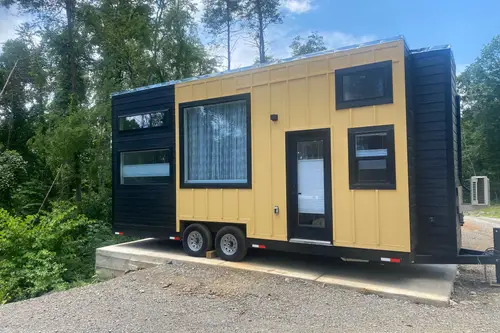
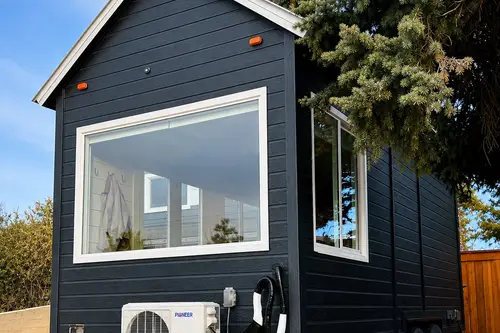
Tiny houses (the deep, liquid market). With 99 listings, this is where $50,000 gives you the most genuine choice. At this budget you are firmly in the range of finished, often-certified tiny homes — typically 300–500 sq ft, frequently on a trailer chassis so they remain legally movable. This is the band where you find the build-spec descriptions that matter: NOAH certification, mini-split HVAC, real loft space, and occasionally included transport. If you want the lowest-risk, most-supported purchase, $50,000 in the tiny-house category is the sweet spot.
Cabins (more square footage, less mobility). Cabins trade portability for space and a sense of permanence. At $50,000 you are generally looking at smaller or more rural builds, and the value can be exceptional on a per-square-foot basis — but you are buying something that stays put, which changes the land and zoning conversation entirely.
Container homes (the design wildcard). With only 4 active container listings, the inventory is thin, but $50,000 reaches well into finished single- and double-container builds. Containers reward buyers who care about a specific industrial-modern aesthetic and durability; they are not where you go for the cheapest dollar-per-foot, but they are unmatched for a distinct look.
Converted buses and skoolies (your home is also your vehicle). Five active skoolie/converted-bus listings sit in our catalog, and this is the category where $50,000 buys the most lifestyle per dollar. A skoolie in this range is typically a substantially built-out conversion — the bus plus tens of thousands of dollars of interior work — and the entire thing moves. For anyone whose answer to "where do you want to live" is "everywhere," $50,000 is a serious skoolie budget.
Campers and park models. The smallest slice of inventory, but worth knowing about: campers can put a road-ready dwelling under $50,000 with budget to spare, and park models offer a residential feel in a community setting.
Geography is the lever you control
Thirty-one states and 99 distinct cities show up across our active listings, but the inventory is far from evenly spread. The states with the most active alternative-dwelling listings right now:
| State | Active listings |
|---|---|
| California | 13 |
| Colorado | 11 |
| Pennsylvania | 10 |
| Texas | 10 |
| Florida | 9 |
| Utah | 8 |
| Georgia | 8 |
Those seven states alone account for 69 of 126 listings — 55% of the catalog. The rest is a long tail of one and two listings per state.
This matters for a $50,000 budget in two opposite ways. If you are location-flexible, the value plays are almost always in the long tail and the lower-cost-of-living states — the Jacksonville and Selma end of the spectrum, where the same dollars buy multiples more square footage. If you are location-locked (you need to be near work, family, or a specific community), your real shopping pool may be two or three listings, and you should treat any well-priced home in your state as a genuinely scarce find.
The single most expensive mistake we see buyers make is assuming alternative housing is uniformly cheap everywhere. It is not. A tiny home in a high-demand western market can cost more per square foot than a conventional house in a cheaper state. Where you are willing to live is the biggest single variable in what your $50,000 actually delivers.
How to actually shop a $50,000 budget on Nomad Adjacent
The data points to a clear strategy. Here is how we would run a $50,000 search:
- Start with the price-per-square-foot question, not the price. Filter the tiny homes for sale and run the math on a handful of candidates. Anything under ~$25/sq ft deserves a hard look even if it needs finishing.
- Decide mobility first. If the home needs to move, you are shopping skoolies and converted buses, trailers, and campers — and you should weight build-out quality over land. If it stays put, you are comparing cabins and container builds, and the land/zoning conversation moves to the front.
- Pick your geography deliberately. Browse the state pages — for example tiny homes for sale in Texas or Florida — and notice how the same budget stretches differently. The long-tail states are where the per-square-foot bargains hide.
- Factor in placement. A $50,000 home is only part of the cost of living somewhere. If you do not own land, look at tiny house communities for lot rent and amenities before you commit — a low lot rent can make a more expensive home the cheaper overall choice.
- If you want it built, not bought, talk to a maker. The tiny home builders directory lists companies who can quote a new build, and $50,000 is a workable starting budget for a modest custom tiny home with many of them.
The bottom line on $50,000 in 2026
The generic articles are not wrong that a tiny home costs "around $50,000." They are just useless, because that average hides everything that matters. Our live inventory tells the real story:
- $50,000 sits at the lower edge of the busiest band in the market, where 54% of all listings live.
- Price-per-square-foot varies by 20x for the same money — meaning location and condition, not size, decide what you get.
- Tiny houses give you the deepest, safest selection; skoolies give you the most mobility per dollar; cabins and containers trade portability for space and style.
- Geography is the lever you control. The value lives in the long-tail states; the premiums concentrate in the high-demand seven that hold over half the catalog.
The smartest $50,000 buyers do not ask "what does a tiny home cost?" They ask "what does this home cost per square foot, where is it, and what will it take to live in it?" That is a question you can only answer by looking at real listings — which is exactly what we built Nomad Adjacent to let you do.
Inventory figures reflect active Nomad Adjacent listings at the time of writing and shift as homes sell and new ones list. Browse the current catalog to see what $50,000 buys this week.