What tiny homes cost in 2026, and where you can legally live in one
The typical tiny house on Nomad Adjacent asks $70,000, or $282 a square foot. Half still listed at day 90 had cut their price. What the law allows in 2026.

Updated
Published under the Nomad Adjacent masthead. This guide was produced with AI assistance and is bylined to the company rather than an individual writer — we don’t attach invented author names to it. Read our editorial standards, or email us to request a correction.
The typical tiny house for sale on Nomad Adjacent asks $70,000. That is the median of the 124 US homes listed for sale on the site on November 11, 2026, and it holds at $70,000 for the 101 of them listed as tiny houses. It is about a sixth of the $417,500 a typical existing American home sold for in September, according to the National Association of Realtors. By the square foot, though, it asks about $282, more than three times what a new manufactured home costs.
Every price here is an asking price, not a sale price, and almost none include land.

A small price for an expensive square foot
The middle half of asking prices on the site runs from about $48,000 to $90,000. Of those 124 homes, 103 (83%) ask $100,000 or less. At $8,500 in Jacksonville, Florida, the seller says the house "will require to be finished". At $8,900 in Tulsa, the home is a renovated 1990 fifth-wheel camper. At the top, a builder's 399-square-foot park model, shown with options, asks $172,000 in Guntersville, Alabama, and the same builder's three-bedroom model asks $171,000.
Size moves the price, though less than in proportion. The median tiny house with a believable stated size is 240 square feet (95 homes). Under 200 square feet the median asks about $48,600 (22 homes), from 200 to 299 about $73,900 (41) and from 300 to 500 about $84,300 (32). The $70,000 also mixes new stock with resales. Of the 52 tiny houses in our sample that give a model year, 18 are 2025 or 2026 models, so don't read it as a used-house price.

Census data put the average new manufactured home in 2025 at $127,200 for the home alone, or about $86 a square foot. A new site-built house cost $168.86 a square foot for the structure in 2024, the latest year Census has published. Our median tiny house asks $282, about 1.7 times that. The median new single-family home finished in 2025 was 2,142 square feet, roughly nine times the size of ours. The savings come from buying far less house. Per foot, a tiny house costs more, and the land is still extra.
Asking prices are flat, and nearly half of sellers cut
Opening prices have barely moved. Tiny houses listed in 2024 started at a median of $67,000 (91 homes). In 2025 it was $65,000 (237), and so far in 2026 it's $68,000 (163). The statistical margins around those three figures overlap, so read them as flat, not rising.
The price after listing is another story. Since October 2024 the site has recorded every price change a seller makes, and we treat changes in the first 24 hours as corrections. Among listings still up after 30 days, 29% had cut their price. By 90 days, half of those still listed had.
The first cut is usually small, a median of 5.8%, or $3,000, about four weeks after listing. Most sellers who cut did it again: 142 of the 252 cut at least twice, and one cut 13 times. By the end, sellers who cut were a median 11% below their opening price. Right now, 38 of the 124 homes in our price sample ask less than they did at some point after their first day on the site.
Treat the asking price as an opening position, especially on a listing that has been up a while. Of the 124 homes in our price sample, 44% have been listed for more than a year.
Most buyers want to live in it full time
Nearly two-thirds of the buyers who said how they'd use the house, 235 of 369, want it as their primary residence. Most of the rest want a second home (21%) or a rental (13%).
Federal rules point the other way. Under 24 CFR 3282.15, a recreational vehicle built and certified to NFPA 1192 or ANSI A119.5 is exempt from the HUD manufactured-home code, and the same rule defines it as "Designed only for recreational use and not as a primary residence or for permanent occupancy." A towed house on wheels without that certification can't use the exemption at all.
This year's big housing law left that rule alone. The 21st Century ROAD to Housing Act became law without the President's signature on July 11, 2026. Section 301 lets a HUD-code manufactured home be built "with or without a permanent chassis." The text never uses the words "tiny," "recreational vehicle" or "park model." HUD said on October 7 that it plans to address foundation, anchoring and installation requirements for the new homes, and gave no dates. None of it reaches a tiny house on wheels directly.
Full-time living is clearest where a state or city has written a specific rule for it. These are the strongest examples we could verify.
- The International Residential Code has a tiny house appendix for a dwelling of 400 square feet or less, not counting lofts. It applies only where a state or city adopts it. Washington includes it in its statewide residential code (WAC 51-51-60104), and Minnesota requires every municipality that has adopted the state building code to administer it (Minn. R. 1309.0010). Most homes on our site (91% of 125 with a believable size) are that small, though sellers may count lofts.
- Maine requires towns to allow a tiny home "on an individual house lot where single-family dwellings are allowed or as an accessory structure, subject to all applicable land use requirements…" Its definition covers a home "designed for use as permanent living quarters," 400 square feet or less, on a frame or chassis and built to ANSI A119.5 or NFPA 1192.
- Portland, Oregon, lets the owner of a house host one occupied RV or tiny house on wheels on a developed lot. The wheels stay on, and it can't be a short-term rental.
- Fresno's city council voted in June 2025 to let a tiny house on wheels count as an ADU or as the main home if it is ANSI-certified, skirted and on an engineered foundation.
- California's housing department lists tiny homes as "Possibly" accessory dwelling units, depending on whether they meet the state's ADU law.
Everywhere else, the answer sits with the county or city.
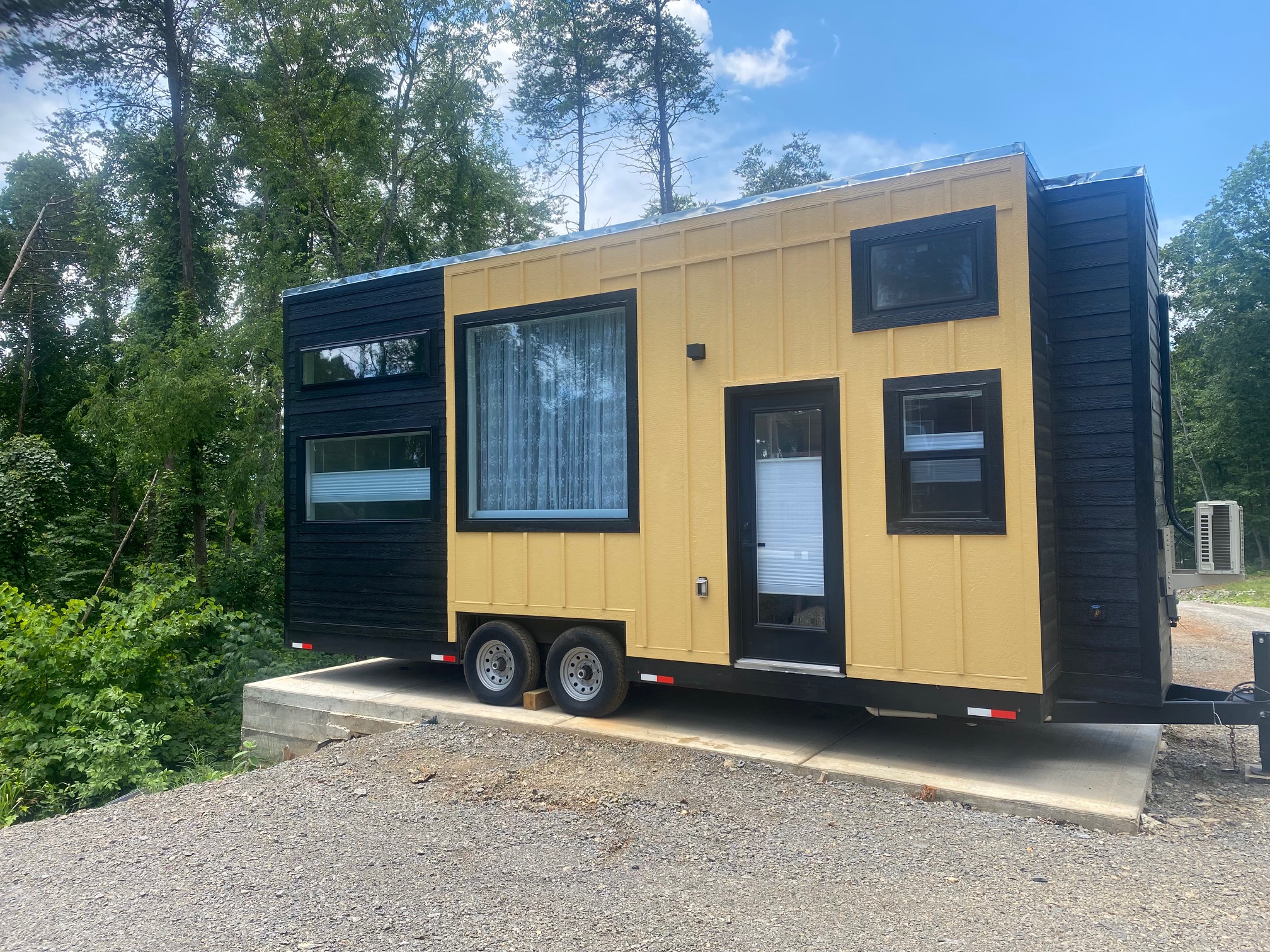
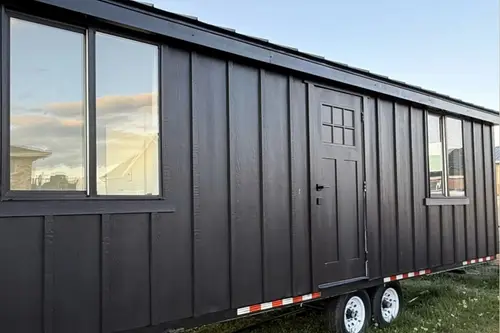
Listings rarely settle the question. The 204-square-foot house above has "NOAH Certified" in its title, which makes it one of only 24 of the 134 live listings (18%) that claim any certification. More than half say nothing about certification, title, permits or zoning. One Utah seller is offering a house at half of what they put into it after they "ran into unexpected city permit issues." A listing in Chico, California, puts the rule plainly: "Buyer is responsible for verifying local zoning, permitting, utility, and placement requirements."
Land and money decide whether it works
About a third of the buyers who said where they'd keep the house (35% of 205) had no land or parking spot yet. Among would-be full-timers it was 46%. Owning land doesn't mean you're allowed to live on it, and our inquiry form doesn't ask about zoning. Still, 77% of the 402 buyers who answered want to buy within about three months.
Cash and financing tie at 39% each of the 368 buyers who answered, with 21% unsure, and primary-residence buyers lean toward borrowing (46%). Budgets are modest: 85% of the 193 who named one, mostly in 2024 and 2025, said $100,000 or less. FHA's Title I manufactured-home loans cover only HUD-code homes, and none of the 134 live listings on our site says it is one. The ROAD to Housing Act set Title I's limit for a single-section home at $106,405 (Section 303) and added building an accessory dwelling unit as a loan purpose.
Some lenders make unsecured loans for tiny homes instead. LightStream, for example, lends $5,000 to $100,000 for them without an appraisal. No house secures a loan like that, so expect a personal-loan rate, not a mortgage rate. Commercial banks charged an average of 11.90% on a 24-month personal loan in the third quarter of 2026, according to preliminary Federal Reserve figures.
Insurance follows certification. The Maryland Insurance Administration warns that "many home insurers won't insure tiny homes that aren't certified by the RVIA or the NOAH," though it adds that a number of specialized tiny home insurers will. Progressive's guidance, last updated in August 2023, says it requires a factory-built home, prefers NOAH certification and won't cover self-built units.
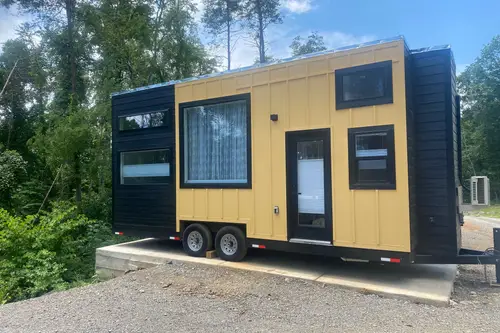
Then there's the rent on a place to park. We couldn't find a reliable national figure for tiny-home villages, so the closest benchmark is manufactured-home communities. Average rent there was $800 a month in the second quarter of 2026, according to Northmarq, and $1,102 in the Pacific region. Five live listings on our site quote a lot rent, from $450 for the Tennessee house pictured above to $1,150 in California. At $800 a month, a spot costs $9,600 a year, and in a little over seven years the rent adds up to more than the median house. Price a spot before you price a house. Our community directory is one place to start.
Before you pay
Before a deposit changes hands, get these.
- The certification, with the label or certificate number and who issued it. Ask to see it on the house as well as in the ad.
- The title or registration, in the seller's name.
- Written confirmation from the city or county where the home will sit that someone can legally live in it there full time. A friendly phone call doesn't count.
- An insurance quote for this specific house, and a loan approved for the full amount before you commit.
- The listing's price history, from the seller. Among listings still up after 90 days, about half have already been cut.
Then open below the asking price, and further below on a listing that has been up 90 days or more. Homes for sale are in search. To order new, start with the builder directory.
How we did this
Platform figures come from Nomad Adjacent's records as of November 11, 2026. Prices are sellers' asking prices and almost never include land. The price sample is 124 US for-sale listings. We left out 10: three builder model pages, a rent-to-own listing whose price is the down payment, a Canadian listing in an unconfirmed currency, a bare $5,000 Tulsa camper listing with no description or photos that appears to repeat the $8,900 one above, two near-identical $6,300 container-house ads, and two duplicate copies of a model listed in three cities (we kept one). Counting all 129 US for-sale listings, the median is still $70,000. Price per foot uses the 95 tiny houses with a stated size of 100 to 500 square feet. Price cuts cover 547 listings created from October 1, 2024, without test, duplicate or never-published rows, and run slightly low because staff edits aren't recorded. Buyer figures come from 474 inquiries, March 2024 to November 2026, without test listings and one spam burst, and every question is optional. Certification and lot-rent claims are as sellers wrote them, unverified.