10 Modular Storage Ideas for Tiny Homes
Modular storage strategies—wall shelves, lift beds, pull-out pantries and hidden compartments—to maximize every inch in tiny and mobile homes.

Updated
Published under the Nomad Adjacent masthead. This guide was produced with AI assistance and is bylined to the company rather than an individual writer — we don’t attach invented author names to it. Read our editorial standards, or email us to request a correction.
10 Modular Storage Ideas for Tiny Homes
Living in a tiny home means every inch counts. Modular storage systems can help you maximize your space with smart, flexible solutions. From wall-mounted shelves to hidden floor compartments, these ideas make small living practical and organized. Here's a quick rundown of the best options:
- Wall-Mounted Shelves: Use vertical space for storage with options like recessed shelves or pegboards. Prices start at $379.
- Stackable Storage Cubes: Double as furniture and cost $20–$200 depending on materials.
- Sofas with Storage: Combine seating with hidden compartments, starting at $500.
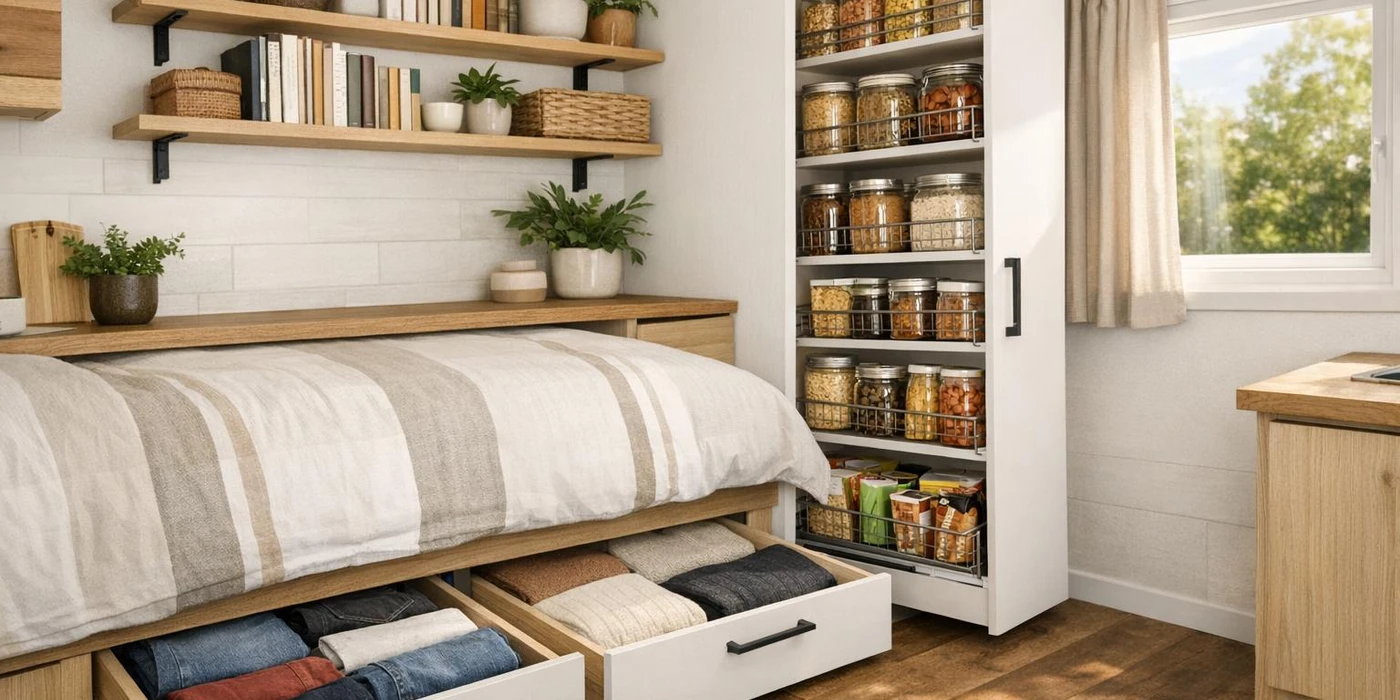
- Lift Platform Beds: Utilize the space under your mattress for $300–$1,500.
- Fold-Down Murphy Tables: Perfect for multi-use spaces, available for $100–$500.
- Pegboards & Rail Grids: Affordable wall storage starting at $30.
- Overhead Ceiling Storage: Great for seasonal items, costing $50–$400.
- Under-Stair Drawers: Custom solutions for $500–$3,000+.
- Sliding Pantry Columns: Ideal for tight spaces, starting at $100.
- Hidden Floor & Bench Compartments: Clever storage for $200–$2,000+.
These solutions cater to both stationary and mobile tiny homes, helping you stay organized without sacrificing comfort or style.
Modular Storage Solutions for Tiny Homes: Features and Cost Comparison
1. Wall-Mounted Shelving Systems
Space Efficiency
Wall-mounted shelving makes the most of unused vertical space, turning walls into functional storage areas. By extending shelves from the floor all the way to the ceiling, you can utilize every available inch rather than stopping at eye level.
"The ceiling is the limit for shelf storage space." - Pratt Modular Homes
One clever option is recessed shelving, which involves embedding shelves into wall studs. This provides 4 to 6 inches of storage depth without encroaching too much on your living area. It’s an ideal solution for tight spaces like bathrooms or kitchens, where every bit of storage matters. Another approach is installing narrow horizontal shelves spaced 8 to 12 inches apart. These can hold a surprising amount without making the room feel overcrowded.
Such efficient designs also lend themselves well to both stationary and mobile tiny homes, offering versatile storage solutions.
Flexibility and Reconfigurability
For adaptable storage, slatwall PVC panels and pegboards are excellent choices. They let you easily rearrange items, whether it’s kitchen tools or heavier equipment, to suit your changing needs.
If you’re looking for something more structured, consider modular bay systems. These start at $379.00 for a basic 24-inch aluminum unit or $715.00 for a wood version. Need more storage? You can expand with additional bays in various widths. For a more polished look, modular units with built-in cabinets start at $969.00. These systems grow with you, making them a practical choice for evolving storage needs.
Suitability for Mobile or Stationary Tiny Homes
Wall-mounted shelving works seamlessly in both stationary and mobile tiny homes, though the setup may vary slightly. In tiny homes on wheels, slatwall PVC panels are particularly helpful. They keep items secure during transit while freeing up floor space. These panels also allow for adjustable or removable mounts, so you can redistribute weight or reconfigure storage as needed. Additionally, high-perimeter shelving near the ceiling is a smart way to store seasonal or less frequently used items, saving the lower spaces for daily essentials.
Cost Range in USD
Wall-mounted shelving systems come in a range of prices to suit different budgets. Aluminum modular units start at $379.00, while wood versions begin at $715.00. If you’re looking for built-in cabinets, expect prices to start at $969.00 and go up from there. While professional installation might add to the cost, most setups can be completed in just one day.
sbb-itb-718b9e4
2. Stackable Storage Cubes
Space Efficiency
Stackable storage cubes are a smart way to make the most of vertical space. By stacking them, you can increase storage capacity without taking up extra floor space - an absolute must when your tiny home measures just 100 to 400 square feet. Typically, these cubes measure around 12 inches on each side, making them perfect for squeezing into tight or oddly shaped areas.
What makes these cubes even better is their versatility. They’re not just for storage; they can double as furniture. Stack them for shelving or reconfigure them into a sofa. Enclosed cubes with doors are particularly handy for reducing visual clutter, which helps create a cleaner, more open feel in small spaces. This vertical storage trick pairs well with other modular solutions mentioned earlier.
"Modular cubes work well in tiny homes because they do double duty, transforming a sofa into a bed, or if the homeowner needs more space, they can stack the units against a wall." - NewHomeSource
Flexibility and Reconfigurability
One of the best features of stackable cubes is their adaptability. You can stack them vertically to save floor space or arrange them horizontally to serve as a low-profile bench or TV stand. Open-backed cubes can even act as room dividers, letting light pass through while separating spaces. As your needs change, you can add or remove cubes with ease. Mixing enclosed and open designs allows you to hide clutter while keeping frequently used items within reach. Plus, many fabric-based cubes collapse flat when not in use and often include carrying handles, making them easy to move around.
Suitability for Mobile or Stationary Tiny Homes
These cubes are a great fit for both stationary and mobile tiny homes, though mobile setups require some extra precautions. In stationary homes, they excel at maximizing every inch of irregular spaces. For mobile homes like RVs or vans, it’s essential to secure the cubes with brackets or straps to keep them in place during travel.
"Modular storage is meant to be disassembled, stacked, or re-configured easily, meaning they may not be able to handle as much weight as permanent fixtures, or could fall over when on the road." - Emily Gleeson, Renovation Expert
Cost Range in USD
Stackable cubes come in a variety of styles and price points, making them accessible to nearly any budget. Fabric collapsible cubes start at about $20 for a six-piece set, while wooden or eco-friendly cubes range between $20 and $25 per unit. If you’re after an industrial vibe, wire grid systems can cost as much as $199 for a four-cube unit. For an eco-conscious option, the Way Basics Eco Stackable Cube offers a sturdy enclosed design for around $25 each.
| Cube Type | Price Range | Best For | Key Feature |
|---|---|---|---|
| Fabric (Collapsible) | $20 (6-pack) | Lightweight items, clothing | No assembly required |
| Wooden/Eco-Friendly | $20–$25 each | Books, kitchenware | High weight capacity |
| Wire/Industrial | Up to $199 | Modern aesthetic, pantry items | High visibility |
3. Sofa with Built-In Storage
Space Efficiency
A sofa with built-in storage is a game-changer for compact spaces, making the most of every inch. These sofas double as seating while hiding storage beneath their cushions. Many designs feature lift-top compartments for larger items like extra bedding or camping gear, while others include sliding drawers for everyday essentials such as books, electronics, or cleaning supplies. As Jubaer Prodhan from Tiny Society puts it:
"The ultimate storage solution here is turn your couch into a mini storage unit by implementing sliding drawers... almost eliminating the need for shelf in the entire living room".
Flexibility and Reconfigurability
Modular storage sofas take versatility to the next level. Their cube-like components can be rearranged to suit different needs, whether it’s hosting a movie night, a dinner party, or creating an open space for activities like yoga. Some designs, inspired by boat-style seating, feature wooden cubes with removable cushions and lift-up lids. Others, like those from Home Reserve, incorporate pet-friendly fabrics and flat armrests to maximize functionality.
Suitability for Mobile or Stationary Tiny Homes
These sofas work equally well in both stationary and mobile tiny homes. They provide convenient storage for daily essentials while keeping everything within reach. For mobile homes, modular designs may need additional brackets or straps to secure lighter pieces during transit. Their adaptability ensures they seamlessly fit into a variety of tiny home layouts.
Cost Range in USD
The price of storage sofas varies significantly depending on the design and materials. Modular systems tend to be pricier, as they’re often semi-customized. Retailers like IKEA and Wayfair offer more budget-friendly options, but costs can climb quickly if you add extra components. On the higher end, brands like Expand Furniture specialize in multifunctional storage sofas designed for maximum space efficiency, though these come with a steeper price tag. For those on a tighter budget, DIY solutions like storage benches or ottomans can save between 10% and 30% on labor costs. By combining seating and storage, these sofas eliminate the need for separate furniture pieces like beds, chests, or shelves, making them a smart choice for tiny living.
| Storage Mechanism | Best For | Typical Items Stored |
|---|---|---|
| Lift-Top Compartments | Bulky, seasonal items | Extra bedding, tools, camping gear |
| Sliding Drawers | Daily essentials | Books, electronics, shoes, cleaning supplies |
| Modular Cubes | Flexible living setups | Items needing reorganization; can form guest beds |
4. Lift Platform Storage Bed
Space Efficiency
A lift platform storage bed cleverly transforms the space beneath your mattress into a hidden storage compartment. Depending on the size, you can gain a significant amount of storage: a Full-sized bed offers 18 cubic feet, a Queen provides 23 cubic feet, and a King gives you a spacious 28 cubic feet of storage. These beds use gas struts or hydraulic systems to effortlessly lift the mattress, revealing a deep compartment that’s perfect for storing bulkier items. This setup eliminates the need for extra furniture like dressers, keeping your living area tidy and organized.
Flexibility and Reconfigurability
Some higher-end models, such as those from Ergomotion, take things a step further by combining lift storage with adjustable bases. These models allow for head and foot articulation, and they often come with built-in LED lighting and USB charging ports for added convenience. The gas struts make lifting the mattress manageable with just one hand, but it's important to check the weight capacity - most Queen-sized options, for instance, can handle up to 123.5 lbs.
Suitability for Mobile or Stationary Tiny Homes
Whether your tiny home is stationary or mobile, these beds are a practical choice. For mobile setups like tiny houses on wheels, the enclosed storage ensures items stay securely in place during transit. In stationary homes, the storage compartment helps maintain a clean, minimalist look. Some mobile tiny home owners even go the extra mile by opting for custom-built lift platforms integrated into the floor or walls. This approach not only maximizes storage but also enhances weight distribution and stability while traveling.
Cost Range in USD
The cost of lift platform storage beds varies based on features and build quality. For budget-conscious buyers, basic metal or upholstered frames can be found for $100 to $300 on sites like Amazon. Mid-range options, which often include perks like LED lighting and charging ports, fall in the $300 to $600 range. At the premium end, adjustable storage bases like the Ergomotion STOW are priced between $1,500 and $2,500. While this model has received a 3.0 out of 5 stars rating from two reviews, users have highlighted its sturdy construction, though some have noted issues with delivery services.
| Bed Size | Approx. Storage Volume | Typical Price Range |
|---|---|---|
| Full | 18 cubic feet | $180 - $350 |
| Queen | 23 cubic feet | $200 - $450 |
| King | 28 cubic feet | $250 - $600 |
5. Fold-Down Murphy Table
Space Efficiency
Fold-down Murphy tables are a game-changer for tiny homes, making the most of limited space. Unlike traditional tables, these modular designs fold flat against the wall or fit neatly into a cabinet when not in use. This clever setup clears up floor space and avoids obstructing narrow layouts. Some models even include built-in shelves, adding extra storage while keeping things tidy. It's a practical solution that shifts effortlessly between different uses.
"The fold-down table is a versatile option for small spaces. You can use one in the kitchen to add counter space to prepare meals as needed, then secure it against a wall when you need your space to perform as a walkway." – Wild Abundance
Flexibility and Reconfigurability
Need a dining table for breakfast, a work desk for meetings, or a craft station for hobbies? Fold-down tables have you covered. These tables adapt to whatever the moment requires. Some innovative designs, like the Lori Beds Murphy Desk, even combine a fold-down bed with a desk that stays level when the bed is lowered. You can also customize the wall-facing side with pegboards, corkboards, or magnetic strips to keep tools and supplies organized.
Suitability for Mobile or Stationary Tiny Homes
Whether your tiny home is stationary or on wheels, fold-down tables fit right in. In a stationary setup, a single room can transform throughout the day - from a bedroom in the morning to an office in the afternoon and a dining area by evening. For mobile homes like RVs or converted vans, these tables are a lifesaver for making the most of tight spaces. Just be sure to secure them with latches and wires to keep everything in place during travel.
Cost Range in USD
If you're handy, a DIY fold-down table can be built with a sturdy board, wire, and latch for a minimal investment. For ready-made options, the IKEA IVAR system offers fold-down desks starting around $150 to $300. Mid-range wall-mounted units with built-in storage typically cost $300 to $600, while high-end custom designs or Murphy bed-desk combos can range from $1,000 to $2,500, depending on materials and features. These options cater to different budgets while staying true to the efficient, space-saving ethos of tiny living.
New Must-Have Storage Products for Tiny Homes (You’ll Be Obsessed!)
6. Pegboard and Rail Storage Grids
Building on the theme of modular storage, pegboard and rail systems provide a smart way to turn empty walls into organized, functional spaces.
Space Efficiency
Pegboards and rail systems transform unused wall areas into efficient storage solutions, leaving your floor space untouched. They’re especially handy in tight spots like kitchen backsplashes, above sinks, or under cabinets - places that often go underutilized in tiny homes. By hanging utensils, tools, or everyday essentials on the wall, you free up counter space for meal prep and other tasks. Keep the items you use most often at eye level for easy access, saving you from digging through deep cabinets or inconvenient loft storage.
Flexibility and Reconfigurability
Pegboards are incredibly versatile and can work in kitchens, offices, closets, or even living rooms. They come in various materials to suit different needs: metal boards are sturdy and perfect for heavier items, wood adds a classic touch and can be customized, while plastic works well in bathrooms since it resists moisture. Most pegboards have standard hole spacings of 1/8-inch or 1/4-inch; the 1/4-inch version is better for heavy-duty hooks and accessories.
"The secret lies in planning your layout meticulously. Start by laying out your tools on a flat surface to get a sense of what you have, then sketch a rough arrangement on paper." – Jason Francis, Author and Tiny House Designer
You can pair pegboards with accessories like straight hooks for tools, curved hooks for pliers to keep them from slipping, double-prong hooks for heavier items, and even magnetic strips or baskets for smaller supplies. Group similar items together, and use labels or colored tape to keep your system organized over time.
Suitability for Mobile or Stationary Tiny Homes
Pegboards are practical for both stationary and mobile tiny homes, though mobile setups require extra care. In a moving home, slotted metal pegboards are a better choice, and you’ll need to secure items to prevent them from shifting during transit.
"If you usually move with your tiny home, make sure to add some way to secure items on these shelves while traveling. You can just put a strip of wood across the frame or add more sophisticated ways to secure your items. An innovative idea is to use magnets to keep everything secure." – Alexis Stephens, Co-founder, Tiny House Expedition
Cost Range in USD
Pegboard systems and their accessories are relatively affordable. A basic metal shelf assembly can cost anywhere from $15.97 for a 4-inch deep unit to $22.97 for a 12-inch deep version. Specialty add-ons like wine bottle holders are priced around $9.97, while modular organizers can run approximately $29.71. Metal pegboards are more expensive than wood or plastic due to their durability and ability to hold heavier items, but they’re a solid investment for storing tools or equipment.
Up next, we’ll dive into more modular systems designed to make the most of every square foot in your tiny home.
7. Overhead Ceiling Storage
Overhead ceiling storage takes advantage of often-overlooked ceiling and corner spaces, helping to keep your floor clear while maximizing storage. By utilizing the area above your head, this method adds extra capacity without making the space feel crowded. It also pairs well with other vertical storage solutions to create a more organized living area.
Space Efficiency
Ceiling-mounted storage systems are particularly useful in kitchens. For example, hanging pot racks with S-hooks can hold pots, pans, dish towels, and coffee mugs, freeing up much-needed cabinet space. Overhead cubes or cabinets along the room’s perimeter can house dry goods and pantry staples. For bulkier items like bikes, surfboards, skis, or kayaks, specialized ceiling racks with pulley systems make it easy to store these items out of the way while keeping them accessible. In addition, pull-down shelving systems with sturdy metal brackets provide convenient access to kitchenware or food items.
Flexibility and Reconfigurability
Ceiling storage solutions come in various forms to meet different needs. Fixed racks and hooks are ideal for items you don’t need often, such as seasonal camping gear or sports equipment. On the other hand, pull-down shelves and retractable racks are perfect for frequently used items, as they can be lowered to eye level when needed. Sliding clear-bin systems mounted on ceiling tracks make it easy to see and access stored contents, while storage nets offer a lightweight option for securing soft or irregularly shaped items like pillows or sports balls.
Suitability for Mobile or Stationary Tiny Homes
Stationary tiny homes can make use of open shelving and high-perimeter ledges for easy access to stored items. Mobile tiny homes, however, require more secure storage solutions. Swing-down boxes that lock into ceiling paneling are a great option to prevent items from falling during transit. Lightweight, non-breakable items like shoes, notebooks, or seasonal clothing are best suited for pull-down compartments to minimize the risk of injury if items shift while on the move. For additional storage in mobile setups, weatherproof under-chassis bins with metal racks designed for road travel can provide extra exterior storage space.
8. Under-Stair Drawer Modules
Under-stair drawer modules transform the often-overlooked space beneath staircases into functional storage. Instead of sealing off this area, these modules create compartments perfect for storing shoes, outdoor gear, or even serving as a broom closet. They can also provide access to loft spaces, potentially replacing traditional closets or pantries altogether. This clever use of space is a prime example of how tiny homes can make the most of every square inch.
Space Efficiency
These modules take full advantage of the staircase depth, often exceeding 20 inches. Placing drawers at foot level ensures easy access. Marc Bilodeau, a tiny house builder, points out that typical tiny house stairs are about 22 inches wide and 10 inches tall, offering plenty of room for modular storage inserts. To make the most of this storage, consider placing heavier items like tools or kitchen appliances in the lower drawers and reserving the upper compartments for lighter items.
Flexibility and Customization
Under-stair storage can be tailored to meet a variety of needs. Options include pull-out pantries, foot-level drawers for heavier items, waist-high cupboards for frequently used items, or hidden compartments for valuables. For a sleek, handle-free look, push-to-open latches can be installed. In stationary tiny homes, modular systems like IKEA PLATSA offer a similar solution without requiring custom carpentry, though they may not fully utilize the angled space beneath the stairs.
Ideal for Mobile and Stationary Tiny Homes
Whether your tiny home is mobile or stationary, under-stair storage can be a practical addition. In mobile homes, securing drawers with soft-close ball-bearing slides (capable of supporting up to 1,200 pounds) and using magnets or wooden strips to fasten shelf frames ensures stability during travel. Bill Bergmann, Associate Editor at Family Handyman, highlights the underutilized potential of this space:
"Builders rarely utilize the space under a staircase; it's much easier to just wall it in than to make custom pullouts. But you can reclaim that wasted space in a couple of weekends."
Cost Range in USD
Building a DIY under-stair drawer system typically costs between $501 and $1,000 for materials. This estimate includes items like Baltic birch plywood, extra heavy-duty 34-inch drawer slides with a 500-pound capacity, and concealed push latches. Costs can vary depending on material quality - premium hardwoods will push the budget higher than construction-grade options. Additional features like integrated lighting or specialized organizers can also increase the price. For those opting for professional custom installations, expect the total cost to rise accordingly.
9. Sliding Pantry Columns
Sliding pantry columns are a clever way to turn narrow, unused spaces into practical storage areas. These pull-out units can fit snugly between a fridge and a wall or even in the slim gap between a bed and a nightstand. Unlike traditional cabinets, where items often vanish into the depths, sliding columns extend fully, making every jar, can, or spice bottle easy to spot and grab. They also make the most of vertical space, running from floor to ceiling, providing ample storage without taking up extra room in your kitchen or living area.
Space Efficiency
Sliding pantry columns are perfect for tight spaces, eliminating the need for wide doors that require clearance. This is especially helpful in the narrow walkways of tiny homes. The full-extension design means no more digging through clutter to find what you need. Some creative homeowners even install these pantries under staircases or in entryways, freeing up valuable counter and cabinet space. For an additional storage boost, toe-kick drawers can be added at the base of the column, utilizing the often-overlooked space behind baseboards.
Flexibility and Reconfigurability
These pantry columns can be customized as either fixed built-ins or mobile units on wheels. The rolling versions are particularly handy, as they allow you to move storage to wherever it’s needed most. A great example is Ana White’s custom slide-out entry pantry, which she crafted using 1x8 boards and 24-inch full-extension slides. It turned an awkward entryway into a functional extension of the kitchen. She shared:
"This cabinet turned out to be one of the most favorite elements of the entire tiny house. By adding the slides to the back of the cabinet, we created a system that was so much more accessible and functional."
This adaptability makes sliding pantry columns a practical choice for both stationary and mobile tiny homes.
Suitability for Mobile or Stationary Tiny Homes
Whether your tiny home is mobile or stationary, sliding pantry columns can be a great fit. However, mobile setups require a bit more planning. To prevent movement during travel, secure the unit and its contents with wooden strips, lips, or magnets across the shelves. Tiny House Expedition offers this advice:
"If you usually move with your tiny home, make sure to add some way to secure items on these shelves while traveling. You can just put a strip of wood across the frame or add more sophisticated ways to secure your items".
For stationary homes, the focus shifts to maximizing depth and accessibility. Full-extension slides are key, allowing the entire column to pull out. To ensure stability, mount the drawer slides to 1x4 boards anchored firmly into wall studs.
Cost Range in USD
Creating a sliding pantry column can be a budget-friendly DIY project. Using standard lumber like 1x8 or 1x10 boards paired with full-extension drawer slides keeps costs down. To ensure smooth operation, install the slides parallel to avoid any binding. For a polished finish, a one-step product like Danish Oil can stain and seal the wood at the same time, giving it a durable, drip-resistant surface.
10. Hidden Floor and Bench Compartments
Hidden floor and bench compartments turn often-overlooked spaces into clever storage solutions, all without eating into your living area. Floor compartments make use of the empty cavities between floor joists, perfect for storing bulky items like sports gear, cleaning supplies, or seasonal decorations. Storage benches, on the other hand, double as seating while discreetly concealing bedding, clothes, or pantry staples beneath removable cushions. As NewHomeSource notes, "Having a trapdoor on the floor to house things like sports or cleaning equipment isn't just a fun feature, it stores things out of sight, and doesn't take an inch away from your living space". This design ensures every square inch is put to good use, making it a smart choice for tiny homes.
Space Efficiency
Floor storage cleverly utilizes structural voids that would otherwise go unused. These compartments can be accessed through trap doors that open from the top or side-access drawers built into raised platforms. For items you use often, side-pull drawers are more convenient than top-loading hatches. Meanwhile, storage benches provide deep compartments for less frequently used belongings - all while functioning as seating. For instance, the Storey Tumlin family, who live in a 240-square-foot converted school bus, customized their couches with hidden storage beneath the cushions to keep bulk items like pasta and peanut butter organized.
Flexibility and Reconfigurability
These storage solutions don’t just save space - they’re also incredibly versatile. Modular storage cubes, for example, can adapt to various needs, transforming from individual seats to a sectional couch or even a guest bed. Unlike fixed floor compartments, these cubes can be rearranged to suit different occasions or moved entirely if you need to reconfigure your space. For heavier lids on benches or clamshell-style beds, hydraulic lift supports (similar to the struts in a car hatch) make opening and closing safer and easier. To maintain a clean and smooth floor surface, recessed or flush pulls are a smart choice, reducing tripping hazards.
Suitability for Mobile or Stationary Tiny Homes
Hidden floor storage works well in both mobile and stationary tiny homes, though mobile setups require a bit more planning. In mobile homes, these compartments can lower the center of gravity by keeping heavy items close to the floor, improving stability. To prevent shifting during travel, items can be secured with wood strips, latches, or magnets . Travel photographer Quin Schrock, for example, spent around $10,000 in March 2020 to add secret compartments to his van conversion, storing everything from electronics to toiletries. In stationary homes, floor hatches can be seamlessly hidden under area rugs or removable carpeting, creating a tidy and polished look .
Cost Range in USD
Building hidden floor and bench storage can be surprisingly affordable, especially if you go the DIY route. Repurposed wooden crates or simple plywood cubes require minimal materials and effort. For mid-range options, modular systems from stores like IKEA (think KALLAX, EKET, or BESTA) offer seating and storage in one. Under-bench or under-bed rolling storage containers typically cost $30–$40 for a 2-pack, while heavier-duty cabinets start at $115 and up. For those wanting a seamless, custom-built look, integrated floor systems are a pricier option. In 2020, one couple constructed an entire cabin with built-in storage features for a total material cost of $7,000. Keep in mind, incorporating floor storage during the initial build is far easier and more cost-effective than trying to retrofit an existing structure.
Comparison Table
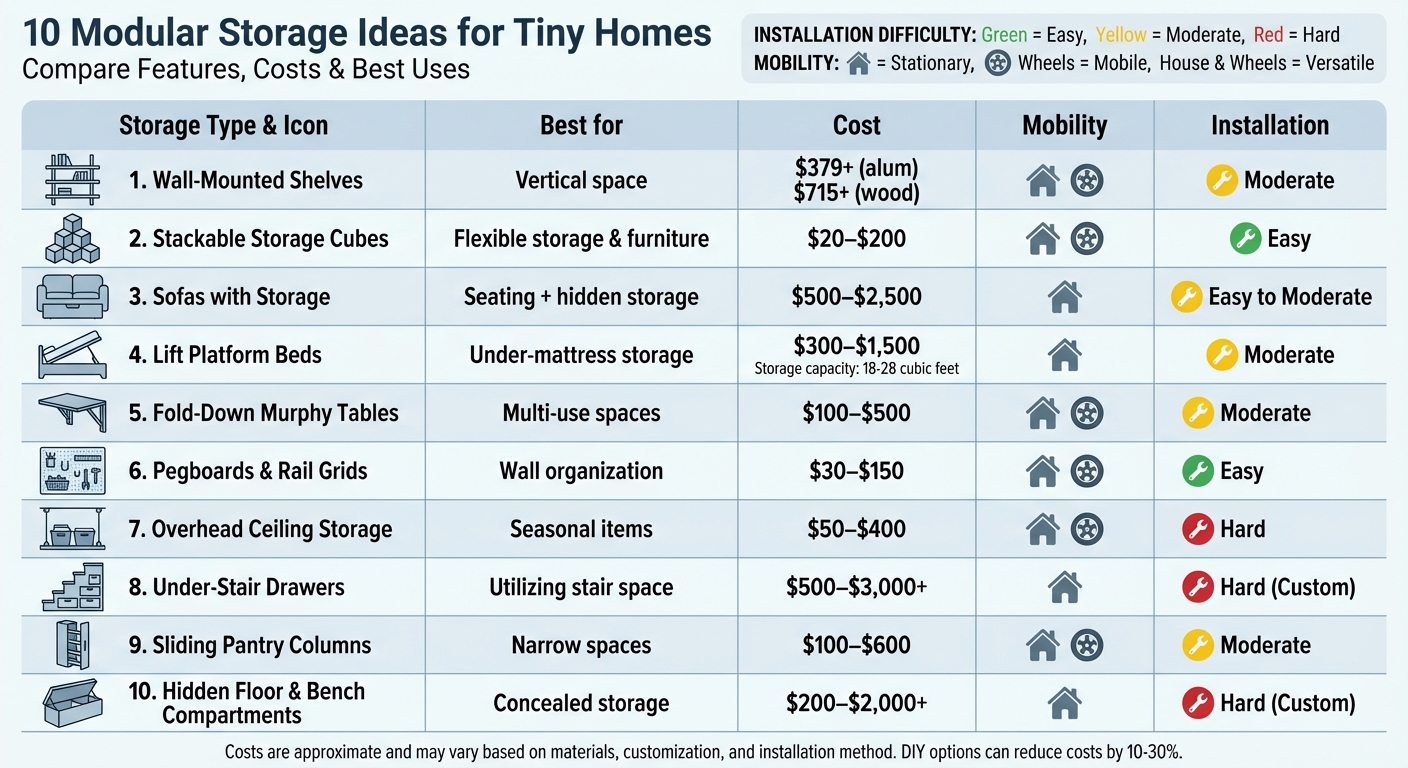
Here's a breakdown of the key features for ten modular storage solutions, highlighting room placement, installation difficulty, mobility, and typical costs. Use this table to find the storage option that best fits your needs.
| Storage Option | Best Room Placement | Ease of Installation | Mobile & Stationary Suitability | Typical Cost Range (USD) |
|---|---|---|---|---|
| Wall-Mounted Shelving | Kitchen, Office, Living | Moderate | Both | $50 – $1,000+ |
| Stackable Storage Cubes | Living Room, Bedroom | Easy | Both | $20 – $200 |
| Sofa w/ Built-In Storage | Living Room | Easy to Moderate | Stationary | $500 – $2,500 |
| Lift Platform Storage Bed | Bedroom | Moderate | Stationary | $300 – $1,500 |
| Fold-Down Murphy Table | Kitchen, Office | Moderate | Both | $100 – $500 |
| Pegboard & Rail Grids | Kitchen, Garage, Office | Easy | Both | $30 – $150 |
| Overhead Ceiling Storage | Garage, Living Room | Hard | Both | $50 – $400 |
| Under-Stair Drawers | Entryway, Living Room | Hard (Custom) | Stationary | $500 – $3,000+ |
| Sliding Pantry Columns | Kitchen | Moderate | Both | $100 – $600 |
| Hidden Floor/Bench | Living Room, Bedroom | Hard (Custom) | Stationary | $200 – $2,000+ |
The installation process varies significantly across these options. Some, like stackable cubes, require only basic assembly, making them ideal for renters or those seeking flexibility. On the other hand, custom-built solutions like under-stair drawers or hidden floor storage demand advanced carpentry and structural modifications, which can drive up costs.
If you're looking to save money, combining DIY efforts with retail options can trim expenses by 10%–30%. Retail solutions, such as pegboards or stackable cubes, offer affordable and flexible storage, while custom builds are better suited for maximizing space in permanent settings. Keep in mind that "easy" installations typically involve simple assembly or hanging, while "hard" projects often require professional skills or structural changes .
Conclusion
The modular storage ideas discussed above transform tiny homes into efficient, well-organized spaces by making the most of every square foot. From utilizing vertical walls to incorporating hidden compartments and multipurpose furniture, these solutions can completely change how small spaces function.
Before diving into storage solutions, take a moment to declutter. As Emily Gleeson wisely points out:
"Modular storage can't solve your problems if you have too much stuff to begin with".
Start by narrowing down your belongings to the essentials - what you truly need and use daily. Once you've pared down, you can choose storage options tailored to your specific needs. With a cleared space, modular systems can genuinely enhance the functionality and comfort of your tiny home.
These flexible systems make even the smallest homes feel more spacious and livable without compromising on usability. Whether it’s fold-down tables that disappear when not in use or overhead storage that keeps the floor open, these solutions adapt to your way of living instead of the other way around.
For more insights on alternative living, check out Nomad Adjacent. They offer minimalist living guides, space-saving tips, and resources for tiny homes, vans, RVs, and beyond.
FAQs
What are some affordable modular storage ideas for tiny homes?
When it comes to affordable storage ideas for tiny homes, DIY wall-mounted shelves and adjustable cube storage units are excellent choices. They’re easy on the wallet and can be customized to fit your needs. You can also use over-the-door organizers for things like shoes, accessories, or even cleaning supplies, and stackable baskets are perfect for keeping smaller items tidy and accessible.
Another smart option is multi-functional furniture. Think beds or ottomans with built-in storage compartments - they save space and serve dual purposes. These practical solutions let you maximize every inch of your tiny home without stretching your budget.
How can I keep modular storage secure in a mobile tiny home?
To keep your modular storage secure in a mobile tiny home, prioritizing stability and flexibility is key. Start with built-in shelving and cabinets securely anchored to wall studs or the chassis. This ensures they stay in place, even when you're on the move. Furniture that serves double duty - like beds with built-in drawers or ottomans with hidden storage - adds functionality while naturally staying secure during travel.
For even more versatility, consider stackable or modular furniture that can be rearranged as needed. Secure these pieces with brackets or bolts to prevent shifting on bumpy roads. Platforms like Nomad Adjacent offer pre-made modular storage kits tailored for tiny homes, making it simpler to find solutions designed for life on the go. With thoughtful planning and multi-purpose furniture, you can make the most of your space while keeping everything safe and secure during your travels.
What are the most flexible modular storage options for tiny homes?
For tiny homes, modular cubes and adjustable furniture systems offer smart ways to make the most of limited space. Think of modular cubes like ottomans or sofa sections with hidden storage - they can be stacked, rearranged, or repurposed to suit your needs. Adjustable shelving and furniture that can be taken apart or reconfigured provide even more flexibility, letting you tweak your setup as your space evolves.
These options help you balance practicality with style. Look for furniture that pulls double duty, like a coffee table that doubles as storage or a bed that folds into the wall. With the right choices, every inch of your tiny home can work harder for you.